


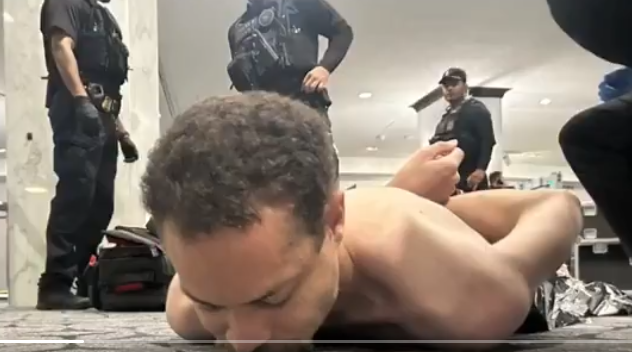
A shocking attempted assassination targeting members of the administration has brought renewed attention to the growing issue of radicalization in the United States. As authorities continue their investigation, new details are emerging about the suspect, his background, and the path that may have led him to such an extreme act.
According to reports, the suspect is a computer scientist and teacher who had previously developed video games, including a first-person shooter. Investigators also revealed that he made a small financial donation to Kamala Harris’ 2024 presidential campaign, adding another layer of complexity to his profile.
Family members have begun to provide insight into his personal life. His sister told authorities that he was associated with a group known as the Wide Awakes and had attended at least one No Kings protest. These affiliations appear to contrast sharply with his earlier life. As recently as 2017, he was using his engineering skills to create assistive technology aimed at helping disabled individuals. One of his projects included a wheelchair braking system designed to lock wheels and prevent unintended movement.
Authorities and analysts are now trying to understand how an individual with a promising background transitioned into someone allegedly capable of attempting political violence. Experts suggest that the answer may lie in a long-term process of radicalization.
Investigators believe the suspect did not act in isolation, even if he carried out the act alone. Instead, they point to what they describe as an “ecosystem” of ideas and influences that may have shaped his thinking over the past decade. During this period, he reportedly moved from being a technically skilled and socially productive individual to someone immersed in increasingly extreme rhetoric.
Details of his movements indicate that he traveled from California by train and made his way to a Hilton hotel, where the alleged assassination attempt took place. His final statements reportedly included phrases such as “taking action,” echoing rhetoric commonly heard in certain protest movements.
The case has sparked a broader debate about the role of political discourse and protest movements in influencing vulnerable individuals. Some analysts argue that repeated exposure to aggressive or hostile narratives against political institutions and leaders can contribute to the development of extremist views.
At the same time, there is ongoing discussion about the nature of the groups he was associated with. While the Wide Awakes group appears, on the surface, to consist largely of artistic and politically left-leaning individuals who promote nonviolence, investigators have not ruled out the possibility that subgroups or online networks within such movements could foster more extreme ideologies.
Experts on radicalization note that such transformations are not uncommon. Drawing comparisons to patterns observed after events like the September 11 attacks, analysts highlight how vulnerable individuals searching for identity or purpose can be drawn into increasingly rigid and extreme belief systems.
Another striking aspect of the suspect’s background is the apparent contradiction in his personal beliefs. While he was once affiliated with a Christian fellowship during his time at university, investigators say that his later writings, including a manifesto, contained anti-Christian sentiments. This shift further underscores the complexity of identity and ideological evolution in cases of radicalization.
Adding to the sense of lost potential, the suspect had previously secured a highly competitive internship at a NASA laboratory, a position that reflects significant academic and technical achievement. Observers have noted the tragedy of a trajectory that moved from innovation and promise to alleged violence.
Authorities continue to search his residence and analyze digital evidence to better understand the motivations behind the attempted attack. While many questions remain unanswered, the case has already intensified conversations about political extremism, online influence, and the psychological pathways that can lead individuals toward violence.
As the investigation unfolds, officials emphasize the importance of addressing radicalization early and understanding how seemingly ordinary individuals can become drawn into dangerous ideologies.
Disclaimer
This article is based on publicly available information and ongoing investigations. Details may evolve as authorities release further updates. The intent is to present factual reporting without endorsing any political viewpoint.