



In a historic first, more than 50% of all U.S. stock trading is now taking place off exchange — happening out of public view through dark pools and internal trading desks at major Wall Street firms.
According to Bloomberg data, off-exchange volume as a percentage of total stock trading has been rising steadily since 2008, but the acceleration in the past few years has been dramatic. What was once a 30% share has now crossed the 50% mark in 2025 — officially meaning the majority of U.S. stock market activity is no longer visible on traditional public exchanges like the NYSE or Nasdaq.
Analysts are calling this a clear sign of growing retail froth and structural change in market plumbing. The curve shows a sharp post-pandemic surge, heavily influenced by high-frequency market makers, algorithmic brokers, and massive retail order internalization by firms like Citadel Securities and Virtu.
This shift raises both opportunity and concern:
• Dark pools were originally meant for large institutions to avoid market impact — today retail flow is being absorbed there as well.
• Market transparency is weakening — pricing power is increasingly controlled by private liquidity players instead of public exchanges.
• Traditional price discovery risks distortion as more trades never hit the lit market.
• Retail mania and options-driven micro-bets are contributing to unprecedented behind-the-scenes volume.
• Regulators, including the SEC, are already under pressure to address fairness and fragmentation risks.
The chart clearly shows a slow rise from around 30% in 2008 to mid-30s through the 2010s — followed by a steep breakout during the 2020 retail boom and another vertical jump from 2023 onward — culminating above the 50% threshold in 2025.
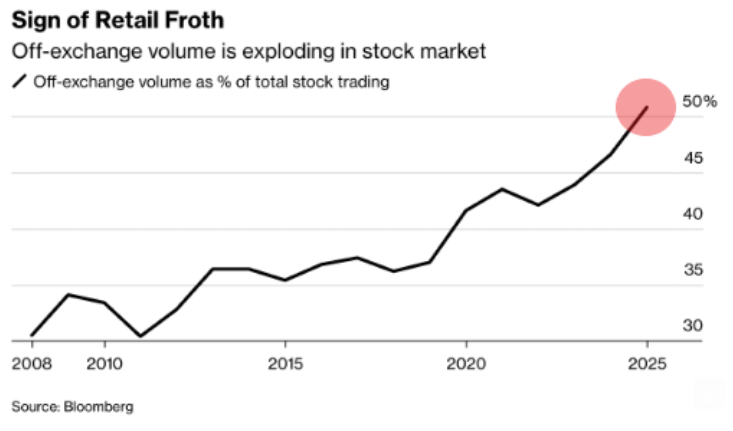
This milestone is more than just a statistic — it confirms that Wall Street has officially moved half of the stock market into the shadows. Investors now face a market where price discovery, liquidity, and transparency are no longer guaranteed to originate from public venues.
The debate ahead is intense — is this innovation or danger?
Disclaimer:
This article is for informational and educational purposes only and does not constitute financial advice. Investors should conduct their own research or consult a qualified financial advisor before making any investment decisions.