


Retail investors are demonstrating unprecedented confidence in equity markets during 2026, aggressively buying stocks during market declines at levels never seen before. New data on retail trading flows shows that individual investors are stepping in as the most aggressive buyers whenever the market falls, continuing a trend that has been developing over the last several years but reaching a new peak this year.
According to the latest market data tracking retail cash flows in the S&P 500, the average daily equity purchases by retail investors on down days in 2026 have reached the highest level on record. This surge highlights how individual investors are increasingly using market selloffs as buying opportunities rather than reacting with panic selling.
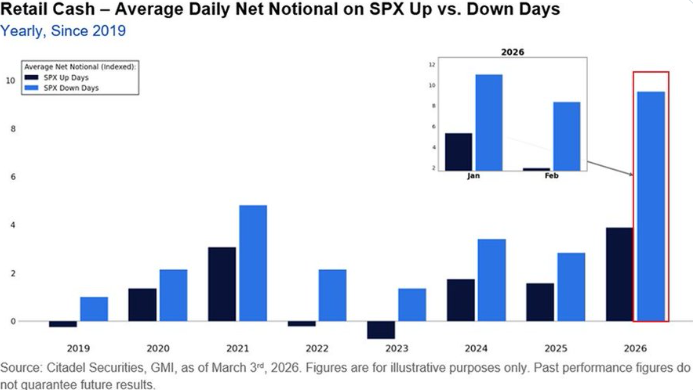
The chart titled “Retail Cash – Average Daily Net Notional on SPX Up vs. Down Days” tracks yearly data since 2019 and shows a clear shift in retail investor behavior. Over the past seven years, individual investors have consistently purchased more equities on days when the S&P 500 declines compared to days when the index rises.
The trend first began to gain attention during the 2020–2021 period, when retail participation surged amid stimulus-driven liquidity and the rise of online trading platforms. During the 2021 meme stock frenzy, retail investors significantly increased their market participation. However, the data shows that the current buying activity in 2026 has surpassed even those levels.
In fact, average daily equity purchases during market declines in 2026 are approximately 100 percent higher than the buying activity recorded during the peak of the 2021 meme stock era. This indicates that retail investors are now far more aggressive in deploying capital during selloffs than they were during one of the most speculative periods in recent market history.
Year-to-date figures reinforce this behavior. So far in 2026, retail purchases on down days are 2.5 times larger than purchases made on up days. This means that when markets fall, retail investors are buying stocks at a significantly faster pace than when markets rise.
Monthly data further highlights the acceleration of this trend. In January 2026, retail purchases on down days were already more than double those on up days, with the ratio standing at approximately 2.1 times. By February, that ratio increased dramatically to 4.3 times, indicating a rapid escalation in dip-buying activity.
This pattern suggests that retail investors increasingly view market pullbacks as strategic entry points rather than signals to exit positions. The behavior also reflects growing familiarity among individual investors with the concept of buying during volatility and holding through market cycles.
Looking back at the yearly data since 2019, retail participation during selloffs has steadily increased. Early years showed relatively modest differences between buying on up days and down days. However, by 2021 the gap widened considerably, and the pattern has remained consistent through 2024 and 2025. Now in 2026, the disparity has reached its highest level ever recorded.
Market analysts note that retail investors appear to be acting as a stabilizing force during periods of volatility. When institutional investors reduce exposure or hedge positions during market downturns, individual investors are stepping in to absorb supply by purchasing equities.
This phenomenon has effectively turned retail traders into the single most aggressive buyers during every market selloff. Their willingness to buy during declines may also reflect broader structural changes in the market, including easier access to trading platforms, commission-free investing, and the widespread availability of market information through social media and financial news platforms.
However, analysts also caution that aggressive dip-buying can carry risks if broader macroeconomic conditions deteriorate. While retail investors have been successful in capitalizing on short-term market declines in recent years, sustained bear markets or economic slowdowns could test the durability of this strategy.
Nevertheless, the current data clearly shows that retail investors are playing a much larger role in market dynamics than ever before. Their growing influence is shaping how markets behave during volatility, with retail money frequently stepping in as the first line of buying support during selloffs.
With retail investors continuing to deploy capital aggressively during downturns, their behavior may remain a critical factor influencing market stability throughout 2026 and beyond.
Source: Citadel Securities, GMI, as of March 3, 2026. Figures are for illustrative purposes only and past performance does not guarantee future results.