

MOSCOW/KYIV – September 23, 2025 – In a rapid and forceful escalation of the ongoing conflict, Russia launched a wave of precision strikes across Ukraine early Tuesday in retaliation for a deadly Ukrainian drone assault on the resort town of Foros in Crimea.
According to Russia’s Ministry of Defense, the overnight operation involved Kinzhal hypersonic missiles, Kalibr cruise missiles, attack drones, and ground-based strike systems, with a focus on high-value military targets linked to Ukraine’s special operations and foreign-backed elements. Moscow claims the strikes resulted in the elimination or injury of up to 250 Ukrainian personnel and the destruction of U.S.-supplied armored vehicles, artillery systems, and ammunition depots.
The Trigger: Ukrainian Strikes in Crimea
The Russian offensive was triggered by a Ukrainian drone attack on Foros in southern Crimea late Sunday, which killed at least three civilians and injured 16 others, including children, according to Sergei Aksyonov, the Kremlin-appointed governor of the peninsula. Debris from intercepted drones also sparked fires near the coastal city of Yalta.
Russia’s Defense Ministry condemned the Foros incident as a “deliberate terrorist act” targeting non-combatants. Eyewitness videos circulating on social media showed thick smoke rising over the Black Sea town, with shattered windows, debris-strewn streets, and emergency responders evacuating the wounded.
Ukrainian military intelligence (HUR) has not officially claimed responsibility for the Foros strike, though Kyiv confirmed recent drone operations targeting Russian military installations in Crimea. These included the destruction of two Russian Beriev Be-12 amphibious patrol aircraft at Kacha airbase near Sevastopol, marking the first losses of their kind in history. Additional operations hit a drone production hub, an ammunition depot, and a Russian S-400 air defense system. A fire at an electrical substation in Russia’s Krasnodar region was also linked to Ukrainian activity.
Kyiv’s leadership has framed these actions as defensive. President Volodymyr Zelenskyy, speaking ahead of his UN General Assembly address, condemned Russia’s “provocations” and called on Western allies to boost Ukraine’s air defenses, arguing that Moscow’s goal is to “terrorize civilians and destroy infrastructure.”
Ukrainian officials have rejected Moscow’s claims that the Foros strike deliberately targeted civilians, suggesting instead that the sanatorium hit may have been repurposed as a military facility—an assertion supported by some open-source intelligence reports.
Russia’s Retaliatory Operation
In its statement, Russia’s Ministry of Defense described the overnight strikes as a “proportional response” to the Crimea drone attack. The campaign targeted a range of sites, including:
Temporary bases of Ukrainian Special Operations Forces (SSO) in the Odessa region, where elite drone and sabotage missions are coordinated.
Positions of foreign mercenaries, particularly a unit allegedly integrated with Western-backed fighters. Russian officials claimed over 100 combatants were neutralized in this strike alone.
Drone production and launch facilities, aimed at crippling Ukraine’s UAV program, which has been central to Black Sea operations and deep strikes.
Ammunition storage and arms depots stocked with Western-supplied munitions.
Moscow further reported the destruction of several U.S.-made M2 Bradley infantry fighting vehicles and M113 armored personnel carriers, key assets delivered under Washington’s multi-billion-dollar aid packages since 2022. Several artillery systems, including towed howitzers and self-propelled guns, were also reportedly eliminated.
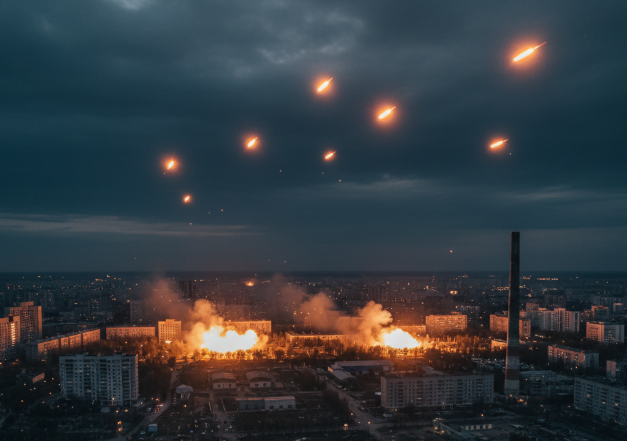
Unverified videos shared on Telegram and X (formerly Twitter) appear to show explosions in Odessa and surrounding regions, with fireballs lighting up the night sky. Independent verification remains ongoing, but analysts from the Institute for the Study of War (ISW) noted that recent Russian strikes have increasingly targeted Ukrainian logistics hubs in an effort to blunt Kyiv’s growing drone offensive.
A Cycle of Escalation
The latest exchange underscores the war’s deepening reliance on drone warfare and precision strikes. Russia recently launched over 600 drones and missiles in a single night on September 20, killing three and wounding dozens across nine Ukrainian regions, including Kyiv and Dnipro.
Ukraine, meanwhile, has intensified its attacks on Russian oil infrastructure, significantly disrupting fuel supplies in Crimea and Russia’s Rostov region.
Diplomatic tensions are also escalating. U.S. President Donald Trump recently stated that Ukraine “won’t get Crimea back or join NATO,” drawing sharp criticism from Zelenskyy, who continues to press for sanctions against Russia and expanded air defense support. Russian President Vladimir Putin has floated the possibility of a temporary U.S.-Russia nuclear arms deal, even as he vowed strong retaliation against “any threats.”
NATO members including Poland have scrambled jets in response to stray munitions, highlighting the growing risks of spillover. At the same time, the humanitarian toll of the war continues to mount. Russia has suffered an estimated 130,000 battlefield losses, according to ISW, while Ukraine faces ongoing blackouts, infrastructure destruction, and mass civilian evacuations.
With winter approaching, experts warn that sustained damage to Ukraine’s energy grid could trigger severe humanitarian crises in the coming months.
Outlook
This latest cycle of drone strikes and retaliatory bombardments signals no imminent path to de-escalation. Both Moscow and Kyiv remain locked in a dangerous tit-for-tat strategy, each seeking to weaken the other’s capabilities while raising the costs of continued conflict.
As the situation develops, Ukraine is expected to renew calls for advanced Western defense systems at the United Nations, while Russia signals readiness for further escalatory measures if attacks on Crimea persist.
This story remains fluid, with independent verification of casualty figures and damage assessments still ongoing.