

Amid rising tensions in the Middle East and escalating military operations against Iran, a U.S. senator and former Navy SEAL has strongly defended President Donald Trump’s strategy, arguing that the current actions are not the beginning of a new war but an effort to end a conflict that has lasted for nearly five decades.
During a recent interview, the senator said he had been briefed by the U.S. Secretary of State only hours earlier and warned that the situation could intensify significantly within the next 24 hours. According to him, the key objective of the operation is to “finish the job” and finally address threats posed by Iran and its network of proxy groups.
The senator emphasized that the current administration does not view the situation as the start of another war. Instead, he described it as the continuation of a long-standing conflict dating back 47 years, arguing that Iranian-backed groups have been responsible for attacks on American citizens and interests around the world for decades. He accused organizations linked to Iran, particularly groups directed by the Islamic Revolutionary Guard Corps (IRGC), of carrying out violent operations and targeting Americans globally.
He also criticized previous U.S. administrations, claiming they had enabled the Iranian regime by providing financial relief and easing pressure on Tehran. According to him, those policies allowed Iran to continue supporting militant groups and expand its influence across the Middle East. He argued that instead of sending large amounts of financial assistance, the United States must now dismantle the networks that allow Iran to project power internationally.
The senator said the current strategy is aimed not only at confronting Iran but also at stabilizing the Middle East. He suggested that weakening Tehran’s network of allied states and proxy groups could significantly reduce regional instability.
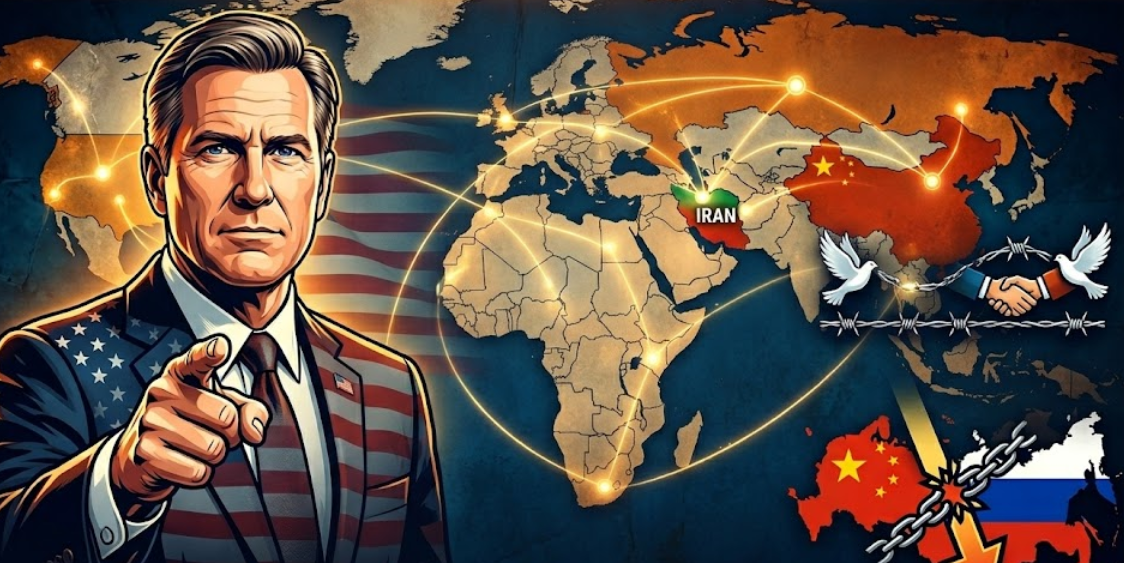
Another major part of the discussion focused on the broader geopolitical implications of the conflict, particularly involving Russia and China. The senator claimed that rogue states such as Venezuela have acted as financial hubs that help Iran-linked groups and other hostile networks move money and resources around the world. He described Venezuela as a “money laundering hub” and an oil laundering center that allegedly enables countries like Russia and China to bypass restrictions and expand their global influence.
According to his argument, these interconnected networks allow rival powers to project power into multiple strategic regions, including Ukraine and the Indo-Pacific. By targeting these systems and weakening the states that support them, the United States hopes to disrupt the broader geopolitical structure that enables these alliances.
The senator also pointed to what he described as failures of the previous administration, arguing that events such as the U.S. withdrawal from Afghanistan undermined global confidence in American leadership. He said that the collapse of the Afghan government erased years of sacrifice and emboldened adversaries around the world.
In his view, those developments helped create an environment in which Iran’s allies and proxy groups gained confidence. He cited attacks carried out by Hamas, disruptions in the Red Sea by Houthi forces, and Russia’s invasion of Ukraine as examples of challenges that emerged during that period.
According to him, the current administration wants to send a clear message that American leadership has changed and that the United States is prepared to confront adversaries more aggressively.
President Trump has also framed the ongoing military operations as part of a broader strategy to eliminate threats posed by the Iranian regime and prevent it from developing nuclear weapons or expanding its missile capabilities.
Supporters of the administration argue that the campaign could weaken networks connecting Iran, Russia, China, and other allied regimes, potentially reshaping the geopolitical balance in several regions. Critics, however, warn that further escalation could lead to a wider regional conflict.
As tensions continue to rise, the next 24 hours are expected to be crucial in determining how the conflict develops and whether the current military campaign expands further across the region.
Disclaimer
This article is for informational and journalistic purposes only. The information presented is based on public statements, interviews, and available reports at the time of writing. Readers are encouraged to consult multiple sources for a comprehensive understanding of ongoing geopolitical developments.