

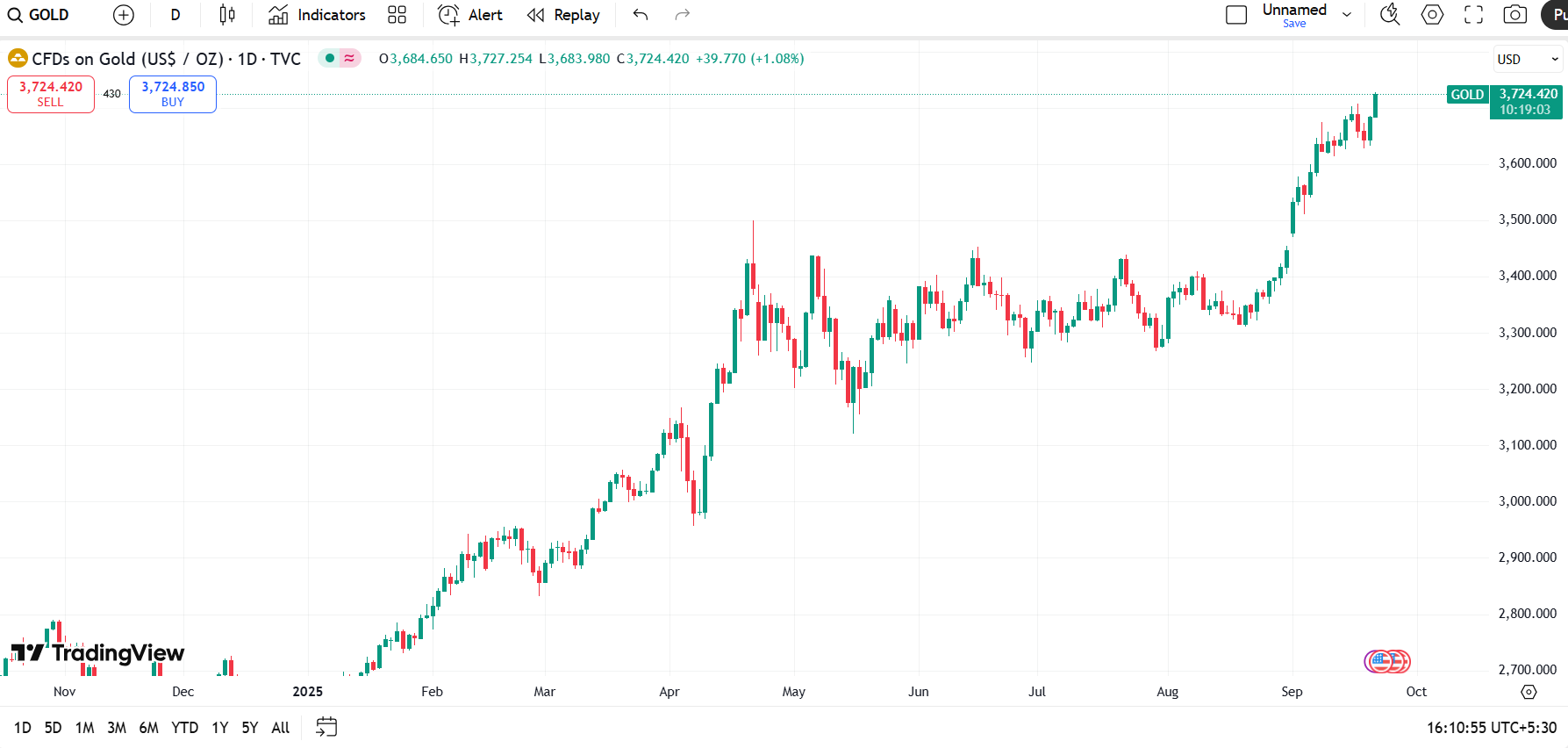
Mumbai, September 22, 2025 – Gold has shattered all records this month, trading at around $3,678 per ounce, up nearly 30% year-to-date and more than double since early 2023. This surge is not a speculative bubble but rather the outcome of deep structural shifts in global finance, central bank strategies, and investor behavior. Below, we break down the key forces propelling gold to new heights.
Gold’s Geopolitical Glow-Up—Why Wars Are Wallet-Savers
Gold has always been a safe-haven asset, but its role has grown stronger amid ongoing global turmoil. Russia’s invasion of Ukraine continues to disrupt energy markets and supply chains, while the Israel-Gaza conflict adds to volatility in the Middle East. Analysts point out that these persistent conflicts have created an environment of instability, making gold the ultimate fear trade. This safe-haven demand has fueled a 35% year-to-date rally. Unlike stocks or bonds, gold’s portability and intrinsic value give investors security during global uncertainty.
Central Banks’ Gold Rush: How Nations Are Betting Big on Bullion
One of the strongest forces behind the rally is central bank buying. Forecasts suggest that central banks will acquire around 900 tonnes of gold in 2025, led by China, Russia, and several emerging economies. This buying spree reflects a broader strategy of de-dollarization as nations reduce reliance on US Treasuries and shift into bullion. J.P. Morgan’s Gregory Shearer describes this as a “revival” of sovereign gold stockpiling, driven by political uncertainty and fears of currency debasement. The scale of this accumulation shows that the gold rush is not just retail-driven hype but a long-term strategic move by nations.
Fed’s Pivot to Cuts: Unlocking Gold’s Golden Era
The US dollar has weakened by 0.5% against major currencies this week, making gold cheaper for international buyers. At the same time, the Federal Reserve is expected to cut interest rates by 25 basis points at its September 17–18 meeting, reducing the opportunity cost of holding non-yielding assets like gold. UBS projects that this dynamic could push gold prices to $3,900 by mid-2026. President Donald Trump has also increased pressure on the Fed, reportedly seeking to replace Governor Lisa Cook for resisting deeper cuts, adding further fuel to market expectations.
Inflation’s Revenge: Why Your Savings Need Gold’s Shield
Inflation remains stubborn at 2.9% in August, well above the Fed’s 2% target. Combined with slowing growth, the threat of stagflation has emerged, echoing the 1970s when gold surged over 2,300%. Investors are again turning to gold as a hedge against currency erosion. Goldman Sachs notes that even a small reallocation of 1% from US Treasuries into gold could drive prices as high as $5,000 per ounce.
From Wall Street to Main Street: The ETF Explosion Driving Gold Mania
Investor inflows are further fueling the fire. Exchange-traded funds (ETFs) saw record subscriptions in August as both institutions and retail buyers rushed in, competing with central banks for limited supply. Morgan Stanley recently lifted its Q4 2025 gold target to $3,800 per ounce, citing this demand squeeze. In India, retail frenzy has pushed 22K gold to ₹10,000 per gram, underscoring the strength of grassroots buying alongside institutional flows. Social media platforms like X are buzzing with predictions that gold will soon breach $3,600 by year-end, though the milestone has already been crossed.
Trump’s Tariff Tempest: How Policy Chaos is Gilding the Lily
US domestic policy risks are adding another layer of uncertainty. President Trump’s renewed trade war proposals and tariff threats could reignite global inflation, while ballooning US national debt—now over $35 trillion—has heightened concerns over financial stability. Goldman Sachs has warned that challenges to Fed independence represent a “tail risk” that could drive investors away from bonds and equities into gold. Analysts suggest that if these risks materialize, gold could hit $4,000 per ounce by month-end.
Quick Market Snapshot
| Factor | Impact on Gold Price | Key Prediction/Source |
|---|---|---|
| Geopolitical Tensions | High (Safe-Haven Demand) | $3,700/oz by EOY (Goldman Sachs) |
| Central Bank Purchases | Very High (Supply Squeeze) | 900 tonnes in 2025 (J.P. Morgan) |
| Fed Rate Cuts | High (Lower Opportunity Cost) | $3,900/oz mid-2026 (UBS) |
| Inflation/Stagflation | Medium-High (Hedge Appeal) | $5,000/oz if Treasuries shift (Goldman) |
| ETF/Investor Inflows | Medium (Demand Boost) | $3,800/oz Q4 2025 (Morgan Stanley) |
| US Policy Risks | Medium (Uncertainty Premium) | $4,000/oz by mid-2026 (J.P. Morgan) |
Conclusion
This historic surge in gold is not just a bubble but a recalibration of trust toward hard assets. With a mix of geopolitical risk, inflation fears, central bank stockpiling, and investor momentum, the yellow metal has cemented its role as the world’s ultimate store of value.
Is gold your portfolio’s missing link? Share your thoughts below. If prices break $4,000 this month—as some analysts predict—it could set the stage for another golden chapter in financial history. Stay golden.