

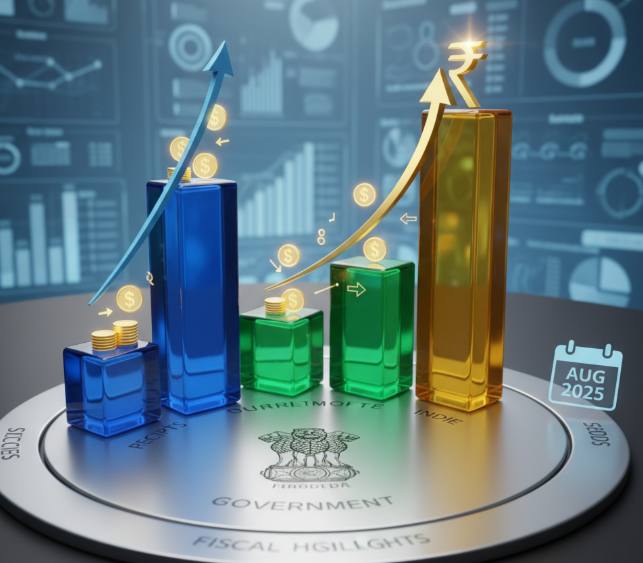
The Ministry of Finance has released the consolidated monthly accounts of the Government of India for the financial year 2025-26, covering the period up to August 2025. The figures provide a snapshot of the Union Government’s revenue collection, transfers to states, and expenditure patterns during the first five months of the current fiscal year.
As per the official data, the Government of India has received a total of ₹12,82,709 crore up to August 2025. This represents 36.7 percent of the corresponding Budget Estimates (BE) for 2025-26 in terms of total receipts. The receipts are primarily composed of three components: tax revenue, non-tax revenue, and non-debt capital receipts.
Tax revenue, net to the Centre, has been recorded at ₹8,10,407 crore, while non-tax revenue has added ₹4,40,332 crore to the government’s coffers. Non-debt capital receipts, which mainly include recoveries of loans and disinvestment proceeds, stood at ₹31,970 crore during this period.
In addition to raising revenue, the central government also undertook transfers to state governments. A total of ₹5,30,148 crore has been devolved to states as their share of central taxes. This amount is significantly higher than last year’s corresponding figure, showing an increase of ₹74,431 crore. The higher devolution reflects stronger tax collection and a commitment to fiscal federalism, ensuring that states have sufficient resources to meet their expenditure responsibilities.
On the expenditure side, the Government of India has incurred ₹18,80,862 crore up to August 2025. This accounts for 37.1 percent of the corresponding BE for 2025-26. Expenditure is divided into revenue expenditure and capital expenditure, and the data shows a clear emphasis on both social sector commitments and capital investments.
Out of the total expenditure, ₹14,49,283 crore has been spent on the revenue account. Revenue expenditure largely includes interest payments, subsidies, salaries, and grants. A closer look reveals that interest payments alone accounted for ₹5,28,668 crore, underscoring the weight of debt servicing in the Union Government’s fiscal management. Major subsidies, which include food, fertilizer, and fuel subsidies, amounted to ₹1,50,377 crore up to August. These subsidies continue to play a critical role in protecting vulnerable households and supporting key sectors of the economy.
Meanwhile, capital expenditure has been recorded at ₹4,31,579 crore. Capital spending by the government typically covers infrastructure development such as roads, railways, power projects, and other long-term assets. The emphasis on capital expenditure highlights the government’s continued focus on boosting economic growth through investments that enhance productive capacity and create employment opportunities.
When comparing receipts and expenditure, it is evident that the fiscal gap remains a significant challenge. While the government has mobilized over ₹12.8 lakh crore in receipts, total expenditure has already reached nearly ₹18.8 lakh crore. The larger portion of resources is being directed towards interest obligations and subsidies, which leave relatively limited fiscal room for other developmental initiatives.
However, the timely transfer of tax devolution to states, coupled with a consistent pace of capital expenditure, signals a balanced approach by the Union Government to manage immediate fiscal pressures while ensuring that growth-related spending is not compromised. The rise in non-tax revenue has also provided an additional cushion to the government’s finances, easing dependence on borrowings in the first half of the fiscal year.
As the fiscal year progresses, the government’s ability to sustain revenue growth and manage expenditure prudently will be key in meeting the fiscal deficit targets outlined in the Union Budget 2025-26. The mid-year review later in the fiscal will provide clearer insights into whether the Union Government remains on track to balance growth imperatives with fiscal consolidation.
The August 2025 monthly accounts provide a comprehensive picture of the financial health of the Union Government. With stronger-than-last-year tax devolution to states, higher non-tax revenue collection, and a steady push on capital spending, the data reflects both opportunities and challenges for India’s fiscal trajectory in 2025-26.