

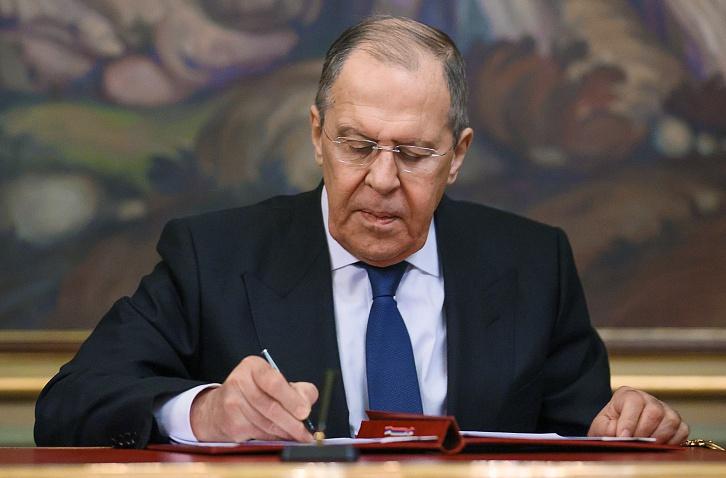
Russian Foreign Minister Sergey Lavrov has delivered one of Moscow's strongest criticisms of Europe since the start of the Ukraine conflict, accusing European leaders of deliberately undermining peace efforts while pursuing a long-term strategy aimed at weakening Russia.
In a lengthy statement titled "Some Reflections on Resolving the Ukrainian Crisis, Europe and Global Security," Lavrov argued that the current security crisis in Europe is the result of decades of Western expansion and what he described as repeated violations of trust by NATO and the European Union.
The statement comes after a June 7 meeting in London involving leaders from the United Kingdom, France, Germany and Ukrainian President Volodymyr Zelensky. According to Lavrov, European leaders presented five conditions for achieving what they called a "just and lasting peace" in Ukraine. Moscow views these demands as an ultimatum rather than a genuine basis for negotiations.
Lavrov claimed that for more than two decades, Russia's attempts to engage with Europe diplomatically were met with continued NATO and EU expansion toward Russian borders. He accused Western governments of supporting political movements in Ukraine, backing the 2014 change of government in Kyiv, and encouraging policies designed to distance Ukraine from Russia.
The Russian foreign minister also revisited the Minsk Agreements, arguing that Germany and France failed to ensure their implementation. Lavrov pointed to past comments by former German Chancellor Angela Merkel and former French President François Hollande, who acknowledged that the agreements helped buy time for Ukraine to strengthen its military capabilities.
According to Lavrov, Russia pursued diplomatic solutions before the outbreak of full-scale hostilities, including proposals for legally binding security guarantees submitted to the United States and NATO in late 2021. He argued that Western rejection of those proposals contributed directly to the current conflict.
Europe's Goal Is Not Peace, Lavrov Says
A major theme of Lavrov's statement was his accusation that Europe is not genuinely seeking peace but rather attempting to preserve Ukraine as a strategic platform against Russia.
He argued that calls for a ceasefire are primarily intended to prevent military setbacks for Ukrainian forces and create conditions for the deployment of foreign military contingents into Ukraine. Lavrov specifically criticized proposals involving Anglo-French military participation, warning that such moves would further escalate tensions.
The Russian foreign minister also accused European institutions of conducting what he described as a campaign of "legal warfare" against Russia through mechanisms such as claims commissions, damage registries and special tribunals intended to investigate alleged Russian actions during the conflict.
Lavrov further criticized recent European discussions about increasing defense spending and achieving military readiness by 2030, claiming that European governments are using the Ukraine conflict to justify massive military expansion.
Warning of Global Security Risks
Lavrov issued a stark warning about the risks facing Europe and the wider world if current trends continue.
He argued that increasing military confrontation between Russia and NATO carries the danger of direct conflict between nuclear powers. The Russian minister expressed particular concern about France's proposal to expand its nuclear deterrence umbrella to additional European countries, describing the move as destabilizing.
According to Lavrov, European leaders continue to promote what he called false narratives about alleged Russian plans beyond Ukraine. He insisted that Russia has no intention of attacking NATO countries and described such claims as political tools used to justify larger defense budgets.
Russia's Conditions for Peace
Despite his criticism of Europe, Lavrov stated that Russia remains open to negotiations. However, he emphasized that any future settlement must address what Moscow considers the root causes of the conflict.
These include guarantees for Russia's security along its western borders, protection of Russian-speaking populations, preservation of Orthodox Christian traditions, and an end to further NATO and Western military expansion.
Lavrov argued that the post-Cold War European security system has effectively collapsed and cannot be restored in its previous form. Instead, he called for the creation of a new Eurasian security architecture that would include all countries across the continent and reflect what Moscow describes as a multipolar world order.
Trust Between Russia and the West at Historic Lows
The statement concluded with a warning that trust between Russia and Western countries has been severely damaged. Lavrov argued that meaningful dialogue cannot be rebuilt through ultimatums and insisted that Europe must demonstrate through actions, rather than words, that it is willing to abandon what Moscow sees as expansionist policies.
He also revealed that British, French and German ambassadors reaffirmed the London conditions during a June 11 meeting at the Russian Foreign Ministry, reinforcing Moscow's belief that European governments remain committed to their current approach.
As the war in Ukraine continues and diplomatic efforts remain stalled, Lavrov's remarks highlight the growing divide between Russia and Europe. The statement suggests that Moscow increasingly views the conflict not simply as a dispute with Ukraine, but as part of a broader geopolitical confrontation with the Western security order itself.
Disclaimer: This article summarizes statements made by Russian Foreign Minister Sergey Lavrov and reflects the Russian government's position. Claims and interpretations presented by Russian officials remain disputed by Ukraine, NATO members, the European Union and Western governments.