

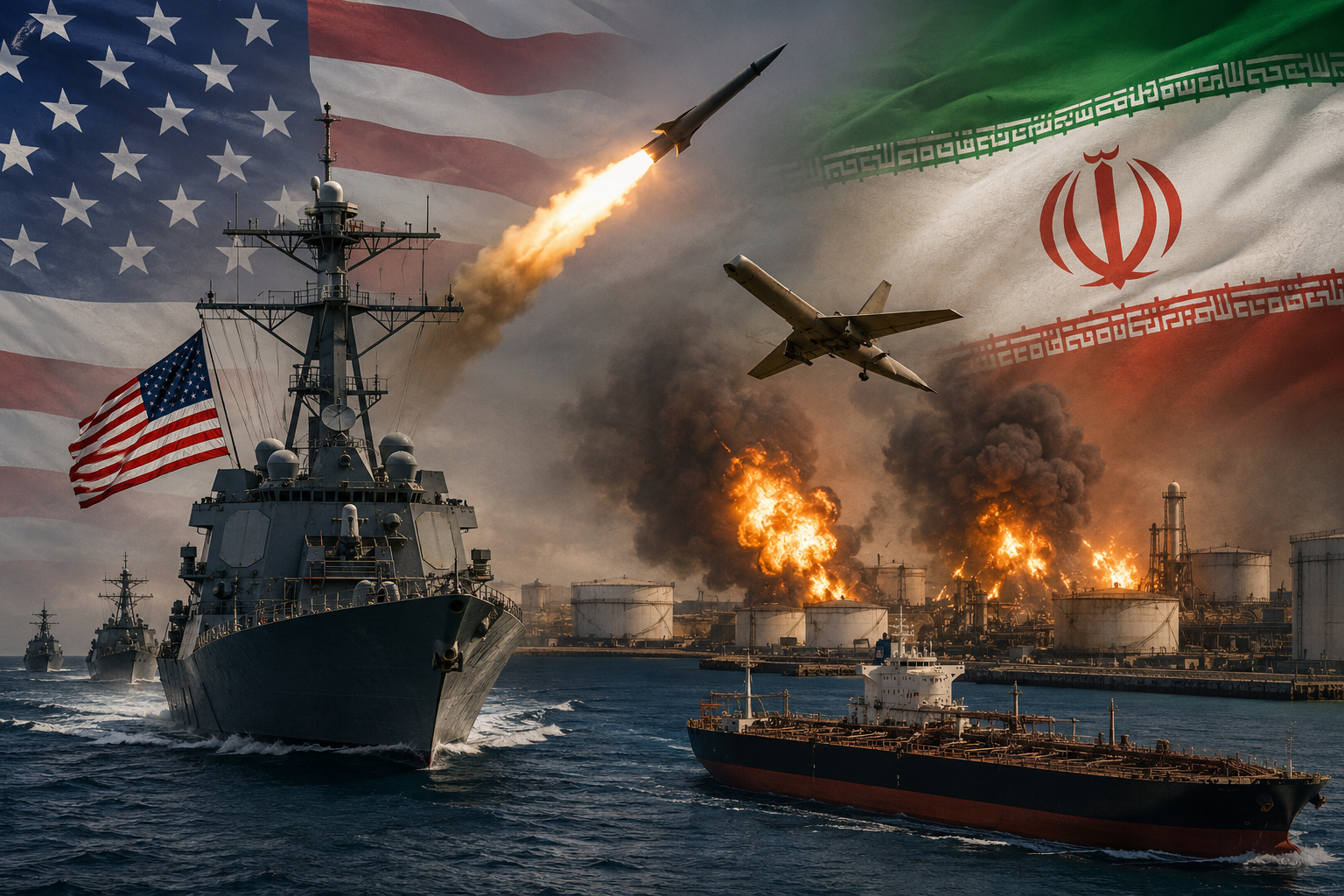
Fresh tensions erupted between the United States and Iran after Iranian drones and missiles targeted American naval vessels near the Strait of Hormuz, triggering a new round of U.S. military strikes on Iranian targets and raising fears of a wider regional conflict.
The latest developments come amid an ongoing U.S.-led blockade aimed at restricting Iran’s oil exports. According to CENTCOM, the blockade has successfully prevented more than 70 oil tankers from entering or leaving Iranian ports. Those vessels are reportedly carrying around 166 million barrels of oil valued at more than $13 billion.
Fox News reported that fighting intensified Thursday when three U.S. guided missile destroyers — USS Truxton, USS Peralta, and USS Mason — were transiting through the Strait of Hormuz into the Gulf of Oman. During the passage, Iranian missiles and drones were launched toward the American ships.
Although none of the destroyers were hit, the warships were forced to take evasive action and intercept incoming threats. Military officials warned that because of the narrow geography of the Strait of Hormuz, any successful strike could have resulted in catastrophic consequences for global shipping and military operations.
Following the attack, U.S. forces launched retaliatory strikes against Iranian military and economic targets. Senior U.S. officials confirmed that American strikes targeted Iran’s island port facilities, missile launchers, and military infrastructure linked to oil export operations.
Fox News also learned that one of the key targets included Iran’s Bandar checkpoint and additional facilities in another strategic port city tied to Iran’s export economy.
Jennifer Griffin reported that additional U.S. airstrikes were carried out Friday morning. These strikes reportedly targeted several empty very large crude carrier ships that were allegedly attempting to bypass the blockade and enter Iranian ports.
The latest escalation comes only two days after Iran reportedly launched 15 ballistic missiles toward the United Arab Emirates. However, U.S. Defense Secretary Pete Hegseth and General Cain stated that the attacks had not yet crossed the threshold of completely breaking the cease-fire agreement currently in place.
Hegseth said that some instability was expected in the early stages of the cease-fire and described the current situation as limited military activity.
General Cain echoed those comments, calling the attacks “low harassing fire” and describing the ongoing exchanges as “low-level kinetics” for now.
Meanwhile, the White House is still awaiting Iran’s official response to the latest U.S. proposal aimed at restarting negotiations.
Secretary of State Marco Rubio stated that the administration expects a response from Tehran soon and hopes it could lead to a more serious diplomatic process.
Rubio also addressed reports suggesting Iran may attempt to establish an agency to control maritime traffic through the Strait of Hormuz. He warned that such a move would be “unacceptable” to the United States.
The situation surrounding the Strait of Hormuz remains one of the biggest concerns for global markets because nearly one-fifth of the world’s oil supply passes through the strategic waterway.
President Donald Trump reportedly had earlier paused “Project Freedom,” an operation designed to reopen the Strait of Hormuz and escort commercial vessels safely through the region. According to reports from NBC News and The Wall Street Journal, the operation was temporarily halted after Saudi Arabia and Kuwait reportedly refused to allow U.S. forces to use their airspace and military bases.
However, following the renewed Iranian attacks and U.S. counterstrikes, that decision was reportedly reversed.
CENTCOM continues to monitor tanker traffic near Iranian ports while U.S. naval forces remain on high alert across the Gulf region.
President Trump stated that the latest U.S. strikes do not signal the end of the cease-fire agreement, but officials acknowledge that continued Iranian attacks could make it increasingly difficult to prevent a larger military escalation.
As tensions rise, global energy markets and international leaders are closely watching whether diplomacy can still prevent a broader conflict in the Middle East.
Disclaimer:
This article is based on publicly available media reports, statements, and broadcast transcripts. The information is intended for news and informational purposes only. Developments in geopolitical conflicts can change rapidly, and readers are encouraged to follow official government and military sources for the latest updates.