

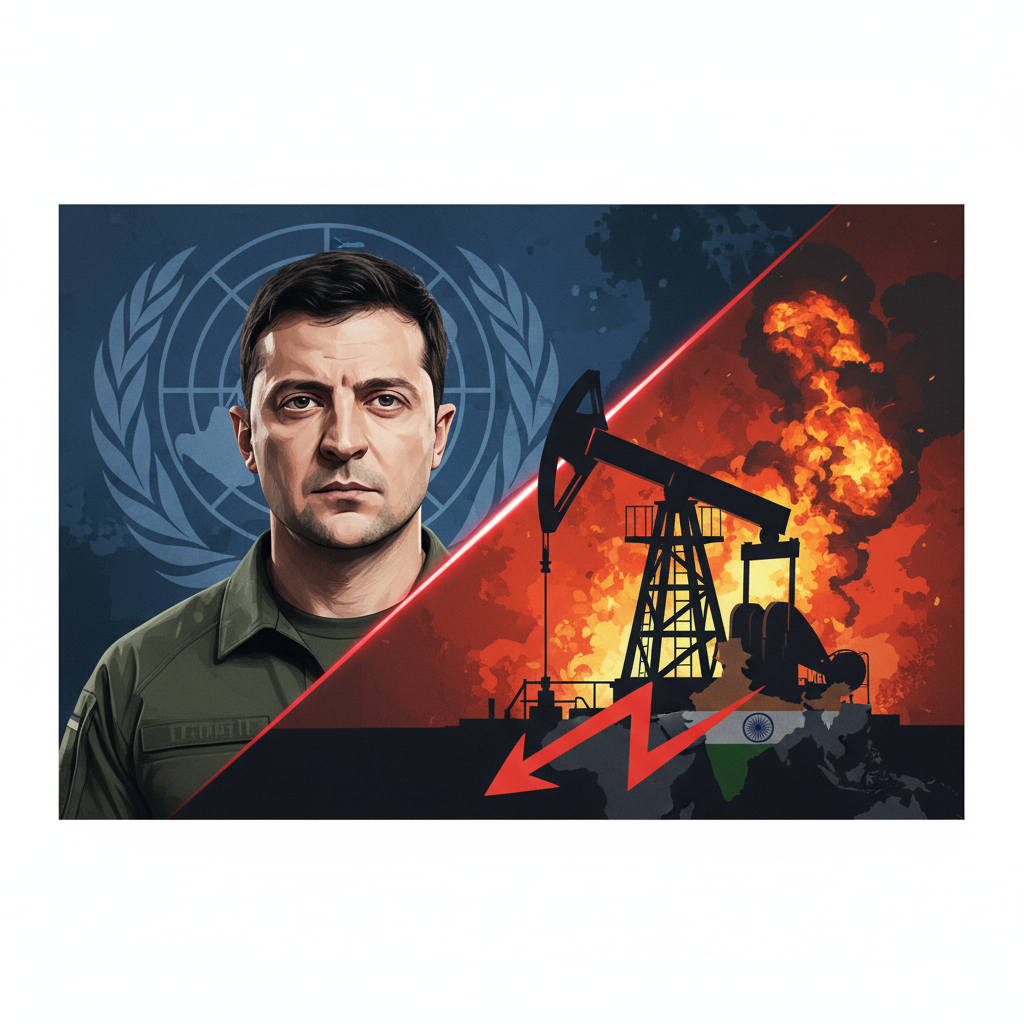
September 24, 2025 – In a dramatic turn at the United Nations General Assembly in New York, Ukrainian President Volodymyr Zelensky directly accused India, alongside China, of prolonging Russia’s invasion of Ukraine by purchasing discounted Russian oil. The pointed remarks came during his high-stakes meeting with U.S. President Donald Trump, marking the sharpest escalation yet in Zelensky’s rhetoric toward New Delhi.
The Incident: What Happened in New York?
The meeting, which lasted about 45 minutes, took place on the sidelines of the UNGA. Zelensky briefed Trump on Ukraine’s latest battlefield gains, claiming the liberation of 360 km² of territory and the encirclement of 1,000 Russian troops. Trump described the discussion as “productive but tough.”
The key moment came when Zelensky, in front of cameras, pivoted from battlefield updates to third-party enablers of Russia’s war effort. Looking directly at Trump, he declared:
“Russia’s economy is collapsing. But this war isn’t ending soon... [because] countries like India and China are funding it by buying their oil. They are strengthening Putin by purchasing Russian oil.”
Trump nodded in agreement, though he did not add further comments on India. The exchange, quickly circulated on X, highlighted the deepening U.S.-Ukraine alignment on tightening sanctions enforcement.
This confrontation followed Trump’s decision in August 2025 to impose 50% tariffs on Indian steel and textiles, directly linking them to India’s Russian oil purchases. Zelensky had endorsed those tariffs earlier this month as the “right idea” to pressure nations trading with Moscow.
Zelensky’s Core Arguments Against India
Zelensky’s accusation against India builds on a narrative he has repeatedly voiced. He argues that India’s massive oil imports are effectively financing Russia’s war budget, undermining sanctions, and prolonging civilian suffering in Ukraine.
Financing the aggressor: Zelensky estimated India’s purchases at roughly $33 billion in FY 2025, contributing to about 40% of Russia’s oil export revenue and sustaining its $100 billion annual war spending.
Sanctions evasion: India refines Russian crude and re-exports diesel to Europe, including Ukraine itself, creating what Zelensky called a “backdoor” that weakens Western sanctions.
Moral imperative: Tying oil revenues directly to battlefield consequences, he declared: “Every barrel bought is a bullet fired,” echoing U.S. Senator Lindsey Graham’s earlier accusation that India’s trade indirectly kills Ukrainian civilians.
Background: Why Now? The India-Russia Oil Row
India has dramatically increased its imports of Russian crude since Western sanctions began in 2022. By 2025, purchases reached 1.5 million barrels per day, up 20% year-on-year. This helped India save nearly $10 billion in energy costs. Reliance Industries, led by Mukesh Ambani, has been at the center of this surge, reportedly purchasing $33 billion worth of Russian oil this year alone, according to a Washington Post exposé published today.
Washington has taken notice. Trump’s tariffs in August were widely seen as retaliation, with U.S. Treasury Secretary Scott Bessent labeling India’s actions “unacceptable profiteering.” Zelensky has publicly sided with this pressure campaign.
At the same time, critics point to hypocrisy. European countries continue to import Russian gas through intermediaries such as Turkey, while the U.S. itself still trades in Russian minerals. Indian officials defend their strategy, arguing, “We buy where we get the best deal,” and framing it as an energy security issue, not a political stance.
Reactions: Global Firestorm Online and in Media
The exchange triggered intense reactions on social media and in international media.
Pro-Ukraine voices:
U.S. hawks like Lindsey Graham amplified Zelensky’s stance, writing, “India’s experiencing the cost of supporting Putin.”
Commentators like @RonFilipkowski argued, “Trump flailing on Ukraine... but at least he’s hitting enablers like India.”
Indian and neutral voices:
Many Indians accused the U.S. and Ukraine of hypocrisy. One post by @pkpitre19 read, “US dances with terrorists, arms Zelensky, trades with Russia—only India’s oil bothers them.”
Another user, @financewsharan, wrote: “India’s caught in a geopolitical chess game... Tariffs to cut funding streams? We’re pawns.”
The hashtag #IndiaStandsWithEnergySecurity trended with over 10,000 mentions, reflecting widespread public sentiment that India must protect its energy needs first.
Media divide:
Western outlets like The Guardian and Washington Post framed the confrontation as “necessary pressure” on India’s “dark side” ties with Russia.
Indian media such as NDTV and India Today highlighted double standards, pointing to Prime Minister Modi’s recent peace calls to Zelensky and questioning why Europe’s energy trade is overlooked.
Reuters reported that India’s imports from Russia actually rose in September despite U.S. tariffs, signaling quiet defiance.
Implications: What Comes Next?
Diplomatic fallout: Zelensky’s remarks risk straining ties further, complicating Modi’s balancing act between Russia, the West, and Ukraine. A rumored Zelensky visit to India in October now looks increasingly awkward.
Economic stakes: Trump’s tariffs are estimated to cost India between $5–7 billion annually. Cutting off Russian oil could push global prices to $150 a barrel, analysts warn, potentially destabilizing world energy markets.
Geopolitical ripple: The episode could strengthen BRICS solidarity between India, Russia, and China, even as U.S.-Ukraine alignment deepens. With Trump pushing tariffs and sanctions harder, India may seek stronger energy partnerships with Saudi Arabia and Iran to offset the pressure.
Conclusion
Zelensky’s blunt accusation has thrown India into the spotlight at the UNGA, raising difficult questions about global energy politics, sanctions, and morality in wartime. While the Ukrainian leader frames oil trade as directly financing Russian aggression, India insists on protecting its national interests. The clash underscores a widening divide in how different nations balance morality, economics, and geopolitics in the ongoing war.