

New York, September 2025 – Chinese Premier Li Qiang delivered a comprehensive and powerful statement at the General Debate of the 80th Session of the United Nations General Assembly, marking both the 80th anniversary of the founding of the U.N. and the victory of the World Anti-Fascist War. His speech reflected deeply on history, current global challenges, and China’s vision for the future of international cooperation.
Li began by highlighting the historical significance of 1945, when the defeat of fascism paved the way for the establishment of the U.N., an institution born out of humanity’s collective determination to move beyond the law of the jungle and build a world based on peace, justice, and cooperation. Over the past 80 years, the U.N. has played an irreplaceable role in global governance, fostering peace, stability, and prosperity, while guiding humanity into an age of digital intelligence and unprecedented development.
Drawing lessons from history, Li outlined three fundamental inspirations. First, peace and development remain the strongest aspirations of all peoples. Humanity, having endured two devastating world wars, must never forget the costs of conflict. The past 80 years of relative global peace have brought economic growth and progress, but Li warned that sustaining this requires renewed commitment to these ideals. Second, solidarity and cooperation are the most powerful drivers of human advancement. From the anti-fascist struggles of the 1940s to overcoming Cold War tensions, financial crises, and pandemics, nations have proven that unity lifts all. Third, fairness and justice are the bedrock of international order.
The lessons of colonialism and great power dominance show that when might overrides right, division and instability follow. True multilateralism, equality among nations, and the rule of law must therefore be upheld.
Li cautioned that today’s world has entered a new period of turbulence and transformation. He criticized unilateralism, Cold War mentality, and the disruption of established international systems, warning that humanity once again stands at a crossroads. He invoked Chinese wisdom: “Never forget why you started, and you can accomplish your mission,” urging nations to stay true to the founding ideals of the U.N.
Reflecting on China’s contributions, Li pointed to President Xi Jinping’s major initiatives, including the Global Development Initiative, the Global Security Initiative, the Global Civilization Initiative, and the Global Governance Initiative. He stressed that the recently launched Global Governance Initiative emphasizes sovereign equality, rule of law, multilateralism, and concrete action, offering a pathway to a fairer international system.
Li then presented four key proposals for addressing current global challenges.
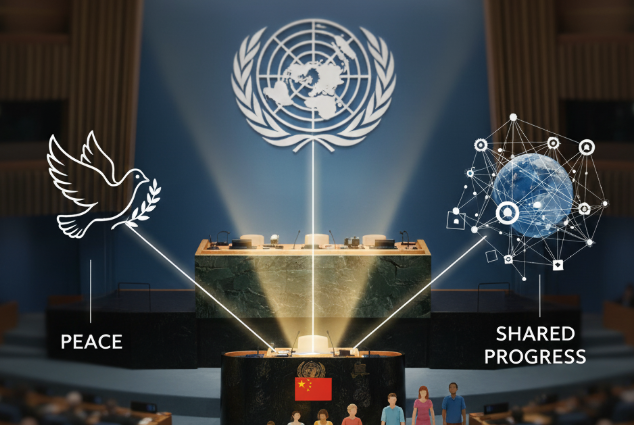
First, he emphasized working together for peace and shared security. All countries, he said, are part of a global village where security is indivisible. Disputes should be settled through dialogue and consultation rather than force or bloc confrontations. China, as the largest peacekeeping troop contributor among permanent Security Council members and the second-largest financial contributor to peacekeeping, continues to promote political settlements in hotspots such as Ukraine and Palestine. This year, China also co-founded the International Organization for Mediation with over 30 countries.
Second, he called for reinvigorating global cooperation for win-win development. Protectionism, tariffs, and barriers are undermining growth, Li warned, and only openness and collaboration can restore momentum. He noted that China contributes about 30 percent to global economic growth, has reduced tariffs to 7.3 percent, and has been the world’s second-largest importer for 16 consecutive years. China also champions sci-tech innovation, sharing advancements in 5G and AI, and continues to expand Belt and Road cooperation with over 150 countries.
Third, Li underlined the importance of dialogue and mutual learning among civilizations. Quoting the saying, “A single flower does not make spring; one hundred flowers in full blossom bring spring to the garden,” he rejected notions of civilizational superiority and urged respect for cultural diversity. China will launch 50 development cooperation programs in the cultural field and host 200 training and seminar programs for developing countries over the next five years.
Fourth, he stressed the need for collective action to tackle emerging challenges such as climate change and technological risks. China has built the world’s largest renewable energy system and announced its 2035 Nationally Determined Contributions at the UN Climate Summit, covering all economic sectors and greenhouse gases. Li also highlighted China’s role in promoting responsible technology governance, including the proposal for a Global AI Governance Initiative and the idea of a World AI Cooperation Organization. During this session, China will present lunar soil samples from Chang’e-6 to the U.N., symbolizing its commitment to shared scientific progress.
Turning to the future of the U.N., Li pledged that China will continue supporting its authority, effectiveness, and reform, while enhancing the voice and representation of developing nations. He announced that China will provide US$10 million to establish a China-U.N. Global South-South Development Facility and will partner with the UNDP to set up a global center for sustainable development in Shanghai to accelerate the 2030 Agenda.
Concluding his address, Li said that the “tide of history surges forward” and expressed China’s readiness to work with all nations to advance multilateralism, pursue peace and development, and build a community with a shared future for humanity. He reaffirmed that a steadily developing, open, and responsible China will bring new opportunities and positive energy to the world.
This address, rich in historical reflection and forward-looking vision, underscored China’s ambition to shape global governance, strengthen multilateralism, and position itself as a leading force in promoting peace, fairness, and cooperation in an era of profound global change.