


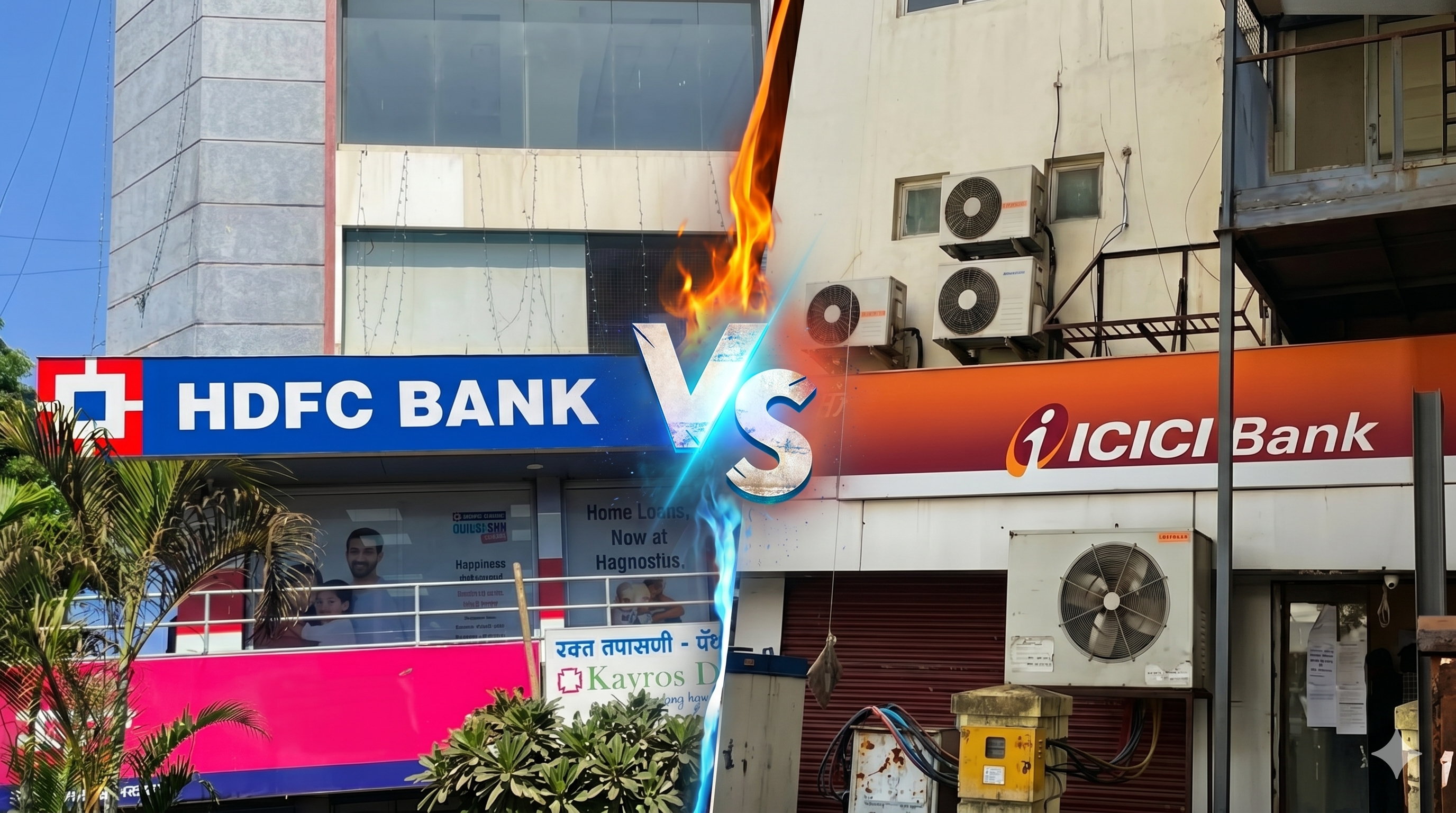
India’s banking sector continues to show resilience as HDFC Bank and ICICI Bank reported their Q4 FY26 results, reflecting steady growth, improving asset quality, and strong balance sheets. Both lenders, which are among the largest private banks in India, delivered numbers that highlight stability in the financial system despite margin pressures and rising provisions.
HDFC Bank Q4 FY26 performance shows stable growth with some pressure on margins. The bank reported net interest income of ₹33,665.77 crore, registering a 4.9 percent year-on-year growth. Net profit came in at ₹19,013 crore, up 8 percent compared to the same period last year. However, net interest margins slightly declined to 3.39 percent from 3.46 percent, indicating some pressure on spreads.
Provisions for the quarter stood at ₹3,448.35 crore, increasing 7.9 percent year-on-year, which suggests a cautious approach towards potential risks. On the asset quality front, gross NPA improved marginally to 1.2 percent compared to 1.24 percent in the previous quarter, showing stability in the loan book.
According to Motilal Oswal’s analyst view, the bank is expected to maintain steady profitability going forward, with return on assets and return on equity projected at around 1.9 percent and 14.6 percent respectively by FY27.
ICICI Bank, on the other hand, delivered a mixed but operationally strong performance in Q4 FY26. The bank reported net interest income of ₹22,704.2 crore, growing 7.1 percent year-on-year. Net profit remained largely flat at ₹12,650.13 crore compared to ₹12,629.58 crore last year, indicating stable earnings despite higher provisioning.
Net interest margin moderated to 4.24 percent from 4.41 percent, reflecting a similar trend of margin normalization seen across the sector. Provisions saw a sharp increase of 65 percent year-on-year to ₹1,477.72 crore, which could be attributed to prudent risk management and buffer creation.
Asset quality improved sequentially, with gross NPA declining to 1.47 percent from 1.53 percent. Additional operational highlights show strong momentum, with loan growth at around 15 percent and deposit growth at about 11 percent. Asset quality further improved to around 1.40 percent, and slippages remained controlled at ₹1,174 crore, indicating disciplined underwriting.
Overall, both banks reported strong underlying trends. Loan growth remained healthy, deposit growth continued to support balance sheet expansion, and asset quality improved across the board. Both HDFC Bank and ICICI Bank remain well-capitalised, providing a strong cushion against macroeconomic uncertainties.
These results are extremely important for the stock markets as well. HDFC Bank and ICICI Bank together hold nearly 20 percent weightage in the Nifty 50 and more than 30 percent weightage in the Bank Nifty. This means their performance has a direct impact on the direction of the broader market.
If market participants react positively to these results, it can trigger a strong rally in the stock markets. Strong earnings, improving asset quality, and steady growth from these two heavyweight banks can boost investor confidence, support index levels, and drive momentum across banking and financial stocks.
The consistent performance of these two banking giants not only strengthens the financial system but also plays a crucial role in shaping overall market sentiment and economic outlook in India.
Disclaimer:
This article is for informational and educational purposes only and should not be considered as financial or investment advice. Stock market investments are subject to market risks. Readers are advised to consult their financial advisor before making any investment decisions. The data mentioned is based on publicly available information and company disclosures.