

Tensions in the Middle East are continuing to rise as U.S. President Donald Trump reportedly considers multiple military options to reopen the Strait of Hormuz, one of the world’s most strategically important oil shipping routes, after Iran imposed heavy maritime restrictions in the region.
The growing standoff comes amid an ongoing U.S. naval blockade targeting Iranian ports and oil exports, while Tehran insists it will maintain control over the Strait of Hormuz until Washington lifts its pressure campaign.
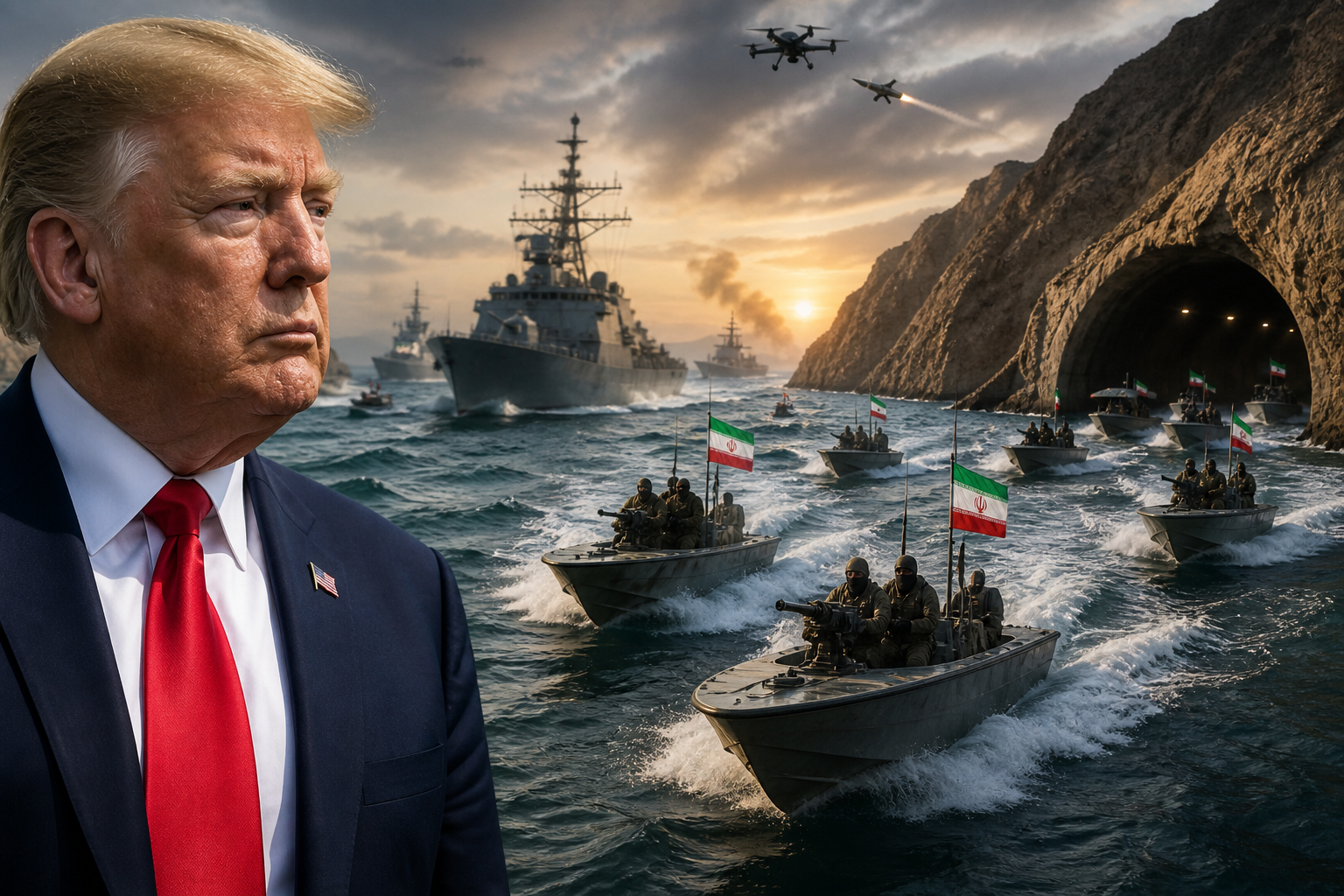
Trump has repeatedly claimed that U.S. forces have already destroyed much of Iran’s naval capability during recent confrontations. However, military analysts warn that Iran’s so-called “mosquito fleet” still poses a serious threat to both commercial shipping and military vessels operating near the narrow waterway.
Iran’s Revolutionary Guard Corps (IRGC) reportedly controls hundreds, and possibly thousands, of fast attack boats specially designed for rapid swarm-style assaults. These small vessels are equipped with machine guns, rockets, missiles, and drones, allowing them to conduct quick hit-and-run attacks against larger targets.
According to military assessments, some of these boats can travel at speeds exceeding 200 kilometers per hour, making them extremely difficult to intercept during coordinated attacks.
The Strait of Hormuz remains one of the most critical maritime chokepoints in the world, with a large percentage of global oil shipments passing through the narrow passage every day. Any prolonged disruption could severely impact international energy markets and global trade routes.
Iran has spent years developing underground military infrastructure near the Strait of Hormuz, including tunnel systems, caves, and hidden naval bases carved into coastal mountains. Footage previously released by the IRGC has shown speedboats emerging from underground facilities believed to be located along the Iranian coastline.
Military experts say the underground network allows Iran to quickly deploy fast attack boats while protecting them from aerial surveillance and missile strikes.
The “mosquito fleet” strategy relies on overwhelming larger vessels through sheer numbers. During a swarm attack, dozens of speedboats rapidly approach a target from multiple directions at the same time, attempting to overload the target’s defense systems before retreating.
Recent incidents in the Gulf have highlighted the dangers of these tactics. Video footage circulating online reportedly showed Iranian fast attack boats intercepting and seizing two container ships accused by Tehran of violating Iranian maritime regulations.
Security analysts warn that similar swarm operations could become far more dangerous if Iran deploys larger numbers of boats against commercial tankers or U.S. naval vessels.
Iranian officials argue that their restrictions in the Strait of Hormuz are a response to the ongoing U.S. naval blockade, which is currently limiting vessels from entering or leaving Iranian ports. Tehran insists that it will continue enforcing control measures in the region until Washington ends the blockade and agrees to broader negotiations.
Meanwhile, the Trump administration maintains that the blockade will remain in place unless Iran agrees to a deal aimed at ending the conflict and addressing concerns surrounding Tehran’s military and nuclear programs.
The situation has significantly increased fears of a wider regional confrontation. Oil traders and shipping companies are closely monitoring developments, as even temporary disruptions in the Strait of Hormuz can trigger sharp increases in global energy prices.
Military analysts believe any attempt by the United States to forcibly reopen shipping lanes could risk direct clashes between U.S. naval forces and Iran’s Revolutionary Guard units operating in the Gulf.
The crisis has also drawn international attention from major oil-importing nations that depend heavily on uninterrupted shipping through the Strait of Hormuz. Several countries are reportedly reviewing contingency plans in case the conflict escalates further.
Despite the growing tensions, diplomatic efforts remain limited, and both Washington and Tehran continue to exchange threats while reinforcing military positions across the region.
As the standoff deepens, the Strait of Hormuz once again stands at the center of one of the world’s most dangerous geopolitical flashpoints.
Disclaimer:
This article is based on publicly available reports, video footage, military analysis, and statements from government officials and media sources at the time of publication. Developments involving Iran, the United States, and the Strait of Hormuz are rapidly evolving, and some claims made by involved parties have not been independently verified. Readers should follow official updates and trusted international news sources for the latest information.