

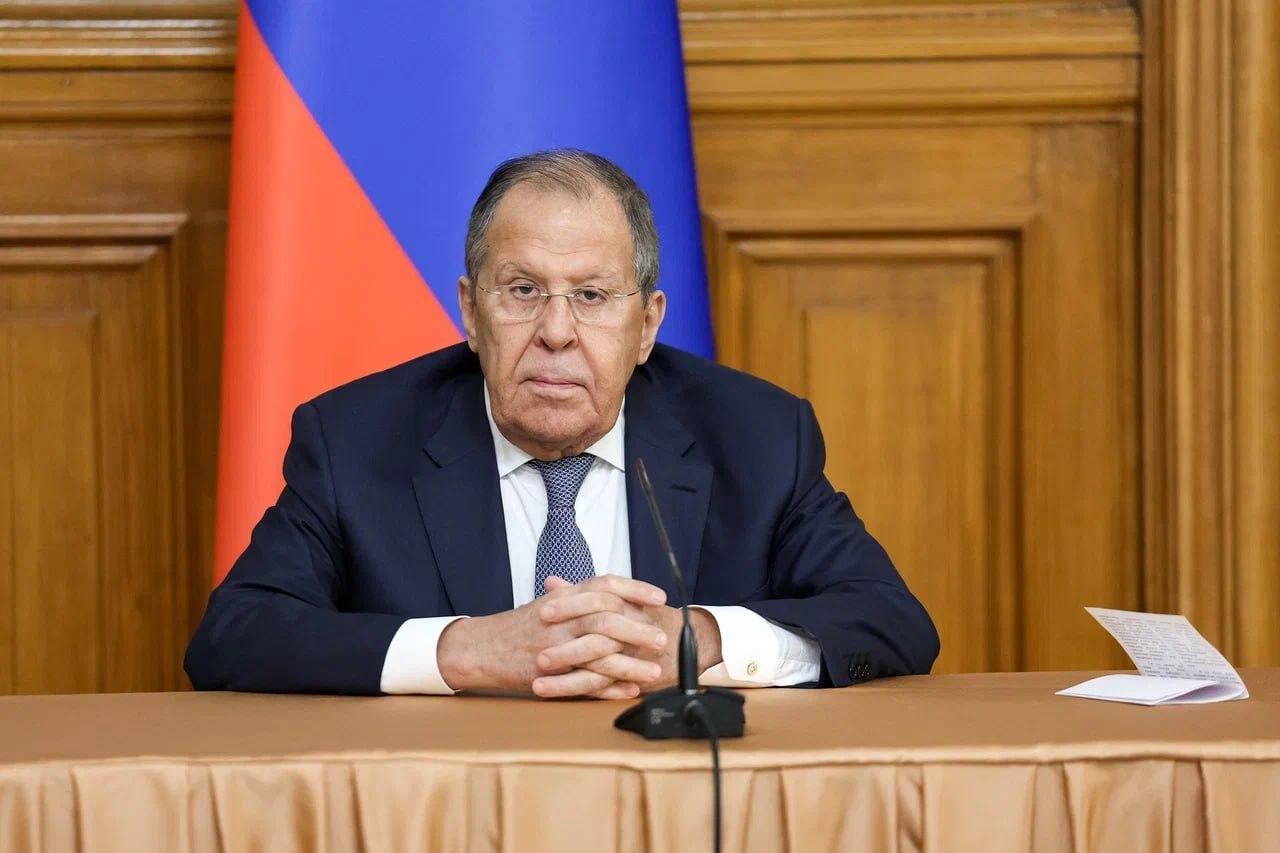
Russian Foreign Minister Sergey Lavrov has launched a sharp criticism of the European Union, NATO and Western policies toward Russia and Ukraine, arguing that Europe is losing its economic strength, political independence and original purpose.
Speaking about Russia’s proposed new Eurasian security architecture, Lavrov said Moscow wants to establish a system in which every country on the Eurasian continent could participate. According to him, such a system would provide ordinary people with greater security, stability and freedom from the threat of military conflict.
Lavrov argued that existing Western institutions, including NATO, the European Union and the OSCE, are increasingly becoming outdated and may eventually lose their relevance.
Lavrov criticises Germany over Russian diplomatic and cultural institutions
Lavrov pointed to Germany's recent actions against Russian institutions as an example of what he described as increasingly hostile Western policies toward Moscow.
He referred to an incident involving a drone crash at Leipzig airport, where German authorities reportedly suspected similarities with drones used by Russia but had not reached a definitive conclusion. Lavrov said Germany nevertheless decided to close Russia's remaining Consulate General in Bonn and the Russian House cultural centre in Berlin.
He described the Russian House as an important symbol of post-war relations between Russia and Germany and criticised the decision to expel Russian diplomats and cultural employees.
Lavrov warned that Russia would likely respond by closing German cultural institutions operating inside Russia, including branches of the Goethe Institute in Moscow, St Petersburg and Novosibirsk.
According to Lavrov, Germany's decision could effectively end its cultural presence in Russia and demonstrate that Berlin prefers political influence through Russian opposition groups abroad rather than open cultural and humanitarian cooperation.
Germany accused of seeking greater influence in Europe
The Russian foreign minister also accused Germany of attempting to dominate political decision-making inside Europe.
Lavrov claimed Berlin was trying to suppress efforts by some European countries to maintain normal relations with Russia. He linked this to his broader criticism of German Chancellor Friedrich Merz and Germany's increasingly confrontational policy toward Moscow.
According to Lavrov, only a small number of EU countries continue to support restoring normal relations with Russia.
EU losing its economic advantages
Lavrov argued that the European Union has changed dramatically from the economic bloc that many countries once wanted to join.
He said the EU previously offered major benefits, including access to subsidies, grants, free movement of people and capital, and a large single market.
However, according to Lavrov, many of these advantages are now being weakened by economic and political problems.
He particularly criticised Europe's migration policies, arguing that the migrant crisis has created growing social and political tensions in several European countries.
Lavrov claimed that the increasing costs associated with migration have contributed to dissatisfaction among European populations.
He also pointed to the large number of Ukrainian refugees receiving financial support and benefits across Europe, arguing that these payments have sometimes caused resentment among local populations.
According to Lavrov, these internal challenges are damaging the economic foundations of the European Union.
Energy crisis and the rejection of Russian gas
One of Lavrov's strongest criticisms focused on Europe's energy policies.
He argued that the EU has severely damaged its own economy by reducing its dependence on Russian energy and supporting policies that have resulted in significantly higher energy prices.
Lavrov also referred to the destruction of the Nord Stream pipelines, describing the incident as a major economic and financial blow to Germany and other European countries.
According to him, European countries previously purchased Russian gas at significantly lower prices under long-term contracts.
He claimed that Europe is now paying far more for alternative energy supplies, including liquefied natural gas.
Lavrov said the high cost of energy has contributed to European companies moving industrial production to the United States, where energy prices and taxes are lower.
He argued that the United States is benefiting economically from Europe's weakening industrial competitiveness.
"The European Union is losing its economic advantages," Lavrov argued, blaming what he described as a lack of foresight by European leaders.
Lavrov attacks European Commission leadership
Lavrov also strongly criticised European Commission President Ursula von der Leyen.
He accused the European Commission of attempting to gain powers that were originally supposed to remain under the control of individual EU member states.
According to Lavrov, Brussels is becoming increasingly centralised and national governments are losing influence.
He also criticised European leaders for asking citizens to accept higher energy costs and economic difficulties in support of Ukraine.
Lavrov questioned what European leaders mean when they refer to "European values" and accused Western governments of ignoring issues related to language and religious rights in Ukraine.
Russia's position on Ukraine and NATO
Lavrov said Russia continues to support what it describes as a realistic settlement of the Ukraine conflict.
He referred to President Vladimir Putin's position that any settlement must take into account the realities on the ground.
According to Lavrov, this represents a major difference between Russia and European governments, which continue to support Ukraine's internationally recognised 1991 borders.
He argued that no realistic political solution can ignore the current military and territorial situation.
Lavrov also repeated Russia's long-standing opposition to Ukraine joining NATO.
He said Ukraine's original declaration of independence described the country as neutral, non-aligned and nuclear-free, but argued that these principles have since been abandoned.
The Russian foreign minister claimed that NATO membership for Ukraine remains unacceptable to Moscow.
He noted that US President Donald Trump had also publicly stated that Ukraine should forget about joining NATO, while NATO officials continue to maintain that Ukraine could eventually become a member of the alliance.
Lavrov says NATO is searching for a new purpose
Lavrov argued that NATO itself is increasingly struggling to justify its continued existence.
He referred to the alliance's involvement in Afghanistan following the September 11, 2001 terrorist attacks and described the campaign as ending unsuccessfully.
According to Lavrov, after Afghanistan, Western governments increasingly focused on portraying Russia as a major security threat.
He also accused NATO of expanding its strategic focus toward Asia, particularly Southeast and Northeast Asia, while attempting to counter China's growing influence.
Lavrov said tensions surrounding Taiwan are being artificially intensified as part of this broader geopolitical strategy.
However, he argued that NATO's attempts to continuously find new reasons for its expansion and existence would eventually lose public support.
Europeans may question rising military spending
Another major issue raised by Lavrov was the rapid increase in defence spending across NATO countries.
He warned that raising military expenditure from 2 percent to 5 percent of GDP could directly affect the standard of living of ordinary citizens.
Lavrov said voters across Europe would eventually begin questioning why large amounts of public money are being directed toward military spending.
According to him, increasing defence budgets could result in reduced spending on social programmes, infrastructure and other domestic priorities.
He argued that ordinary Europeans would increasingly question whether their governments' military policies are improving their security or damaging their economic well-being.
Russia proposes a new Eurasian security model
Against what Lavrov described as aggressive Western military structures, Russia is promoting a new Eurasian security system based on dialogue, consensus and the participation of all countries across the continent.
Lavrov said Russia's proposed model would not rely on military blocs or political pressure.
Instead, he argued that decisions should be made through consensus and general agreement among participating countries.
He acknowledged that reaching consensus can be slower and more difficult than decisions imposed by powerful countries or military alliances.
However, Lavrov argued that agreements reached through consensus are stronger and more stable in the long term.
According to him, the proposed Eurasian security system could eventually replace the influence currently exercised by Western institutions such as NATO and the European Union.
Conclusion
Lavrov's latest remarks represent one of Moscow's strongest recent criticisms of Europe's political and economic direction.
The Russian foreign minister argues that the European Union is sacrificing its economic advantages, while NATO is increasingly dependent on new geopolitical conflicts to justify its existence.
Moscow, meanwhile, is promoting a different vision for Eurasia based on a broader security system involving countries across the continent.
Whether Russia's proposed Eurasian security architecture gains international support remains uncertain. However, Lavrov made clear that Moscow believes the current Western-led security system is approaching the end of its political and strategic relevance.
The future of Europe's relationship with Russia, the Ukraine conflict, NATO expansion and the development of a possible new Eurasian security framework are likely to remain among the defining geopolitical issues of the coming years.