

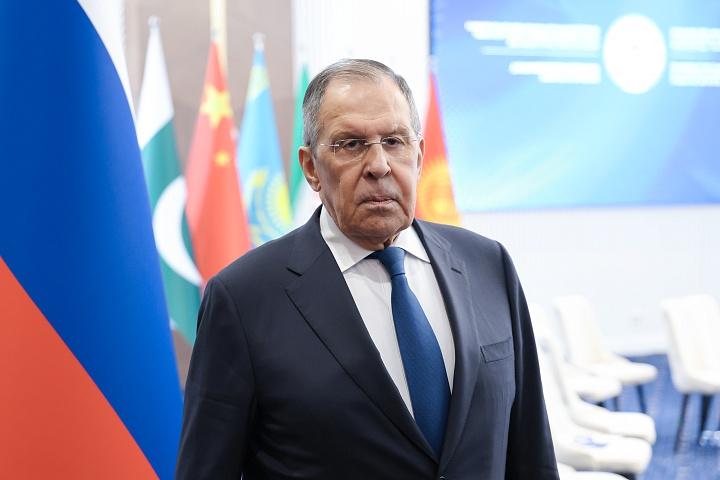
Russian Foreign Minister Sergey Lavrov has argued that Russia continues to encounter what it considers broken promises from Western countries because “deception lies in the foundation of Western diplomacy.”
Responding to a question about why Russians continue to expect fair treatment despite what Moscow describes as repeated Western betrayals, Lavrov said the issue was not simply naivety but an enduring hope that agreements and promises would ultimately be respected.
He referred to Russia’s historical culture of patience, citing traditional sayings and the legendary Russian epic hero Ilya Muromets, who, according to the story, remained on a stove for 33 years before being called upon to serve his homeland.
Lavrov argued that Russia’s willingness to continue expecting commitments to be honored should not be interpreted as a lack of historical awareness.
Lavrov points to NATO expansion
A major part of Lavrov’s argument focused on NATO’s post-Cold War expansion.
He referred to the 1999 OSCE summit in Istanbul, arguing that its declaration contained principles stating that no country or organization should strengthen its security at the expense of others and that no state or organization in the Euro-Atlantic area should seek dominance.
According to Lavrov, NATO subsequently acted contrary to those principles by continuing its expansion.
He also cited the memoirs of former Russian Foreign Minister Yevgeny Primakov and former U.S. Ambassador to the Soviet Union and Russia Jack Matlock. Lavrov said Matlock had confirmed that assurances were given that NATO would not expand following German reunification.
Lavrov argued that the alliance ultimately expanded beyond eastern Germany to other countries in Central and Eastern Europe.
“It was verbal” — Moscow’s account of the dispute
Lavrov described what he portrayed as a series of Russian attempts to obtain clarification over Western commitments.
According to his account, when Russia questioned why NATO expansion continued despite assurances, Western officials responded that the earlier commitments had been verbal.
Lavrov then pointed to the 1999 Istanbul declaration, saying that the principles had subsequently been put into writing.
But, according to Lavrov, Russia was told that the Istanbul document was only a political declaration and was therefore not legally binding.
He said Moscow subsequently tried another approach in 2008 by proposing a legally binding agreement that would translate the principles contained in the OSCE framework into formal legal obligations.
Lavrov claimed that Western governments did not engage with the proposal.
Russia’s 2021 security proposals
Lavrov also connected the issue to the events preceding the current Russia-Ukraine conflict.
He recalled that in December 2021, Russia proposed treaties with the United States and NATO concerning European security.
Moscow's proposals sought new security arrangements covering NATO's relationship with Russia and restrictions concerning military infrastructure and further alliance expansion.
Lavrov presented the proposals as what he described as Russia’s final major effort to prevent the crisis surrounding Ukraine from escalating into a full-scale conflict.
The proposals were rejected by the United States and NATO, although Western governments said they were willing to discuss certain security concerns while rejecting key Russian demands.
Lavrov revisits the 2014 Ukraine crisis
The Russian foreign minister then turned to Ukraine and the events surrounding the collapse of Viktor Yanukovych’s government in February 2014.
Lavrov highlighted the agreement reached on February 21, 2014, between then-Ukrainian President Viktor Yanukovych and opposition representatives.
The agreement was witnessed and supported by the foreign ministers of Germany, France and Poland.
It envisaged constitutional reforms, the formation of a government of national unity and early presidential elections.
However, Lavrov said that the agreement was effectively abandoned the following day when opposition forces took control of government buildings and established what they called a “government of victors.”
He argued that this demonstrated another example of Western-backed commitments failing to produce the outcome Moscow had expected.
Dispute over Yanukovych’s departure
Lavrov also challenged the characterization of Yanukovych’s movements during those days.
He referred to statements made between February 22 and 24, 2014, by several Western leaders and officials, including then-French President François Hollande, then-German Foreign Minister Frank-Walter Steinmeier, German Chancellor Angela Merkel and British Foreign Secretary William Hague.
According to Lavrov, these officials described the events as the Ukrainian people taking power into their own hands and said Yanukovych had left.
Lavrov disputed that interpretation.
He said Yanukovych was in Kharkiv attending a congress of his Party of Regions and argued that he had not simply fled Ukraine at that point.
Lavrov acknowledged that Yanukovych was not necessarily welcomed at the congress but maintained that he remained inside the country.
Moscow’s broader argument
Lavrov's comments form part of a broader Russian argument that the post-Cold War European security order failed because Western countries, in Moscow’s view, did not honor political commitments or take Russian security concerns seriously.
The Russian government has repeatedly pointed to NATO enlargement, the 2014 political crisis in Ukraine and the failed Minsk agreements as examples of what it describes as Western commitments that were ultimately disregarded.
Western governments strongly dispute Moscow’s interpretation of these events. NATO has maintained that the alliance’s expansion was based on the sovereign decisions of countries seeking membership, while Western officials have rejected the idea that Russia was given a legally binding promise that NATO would never expand eastward.
The history of NATO enlargement, the interpretation of post-Cold War assurances and the events of 2014 therefore remain deeply contested issues between Moscow and Western capitals.
Lavrov’s latest remarks place those disputes within a wider argument: that Russia should no longer assume that Western political assurances will necessarily be honored, even when they are presented through formal diplomatic frameworks.
Disclaimer: This article reports and contextualizes Sergey Lavrov’s statements. Claims made by Russian officials, including allegations concerning Western deception, NATO commitments and the 2014 Ukraine crisis, represent the Russian government’s position and are disputed by Western governments and other parties.