


In a major policy shift that could impact thousands of skilled foreign workers, the U.S. government has issued new restrictions on the entry of certain H-1B nonimmigrant workers. The directive comes after President Donald Trump issued a proclamation on September 19, 2025, titled Restriction on Entry of Certain Nonimmigrant Workers, which aims to address what the administration calls systemic abuse of the H-1B visa program.
According to the memorandum issued by Joseph B. Edlow, Director of the U.S. Citizenship and Immigration Services (USCIS), the proclamation specifically restricts the entry of foreign nationals seeking to work in specialty occupations under section 101(a)(15)(H)(i)(b) of the Immigration and Nationality Act (INA). This restriction applies unless their petitions are supplemented by a payment of $100,000. The new guidance affects H-1B employment-based petitions filed after 12:01 AM Eastern Time on September 21, 2025.
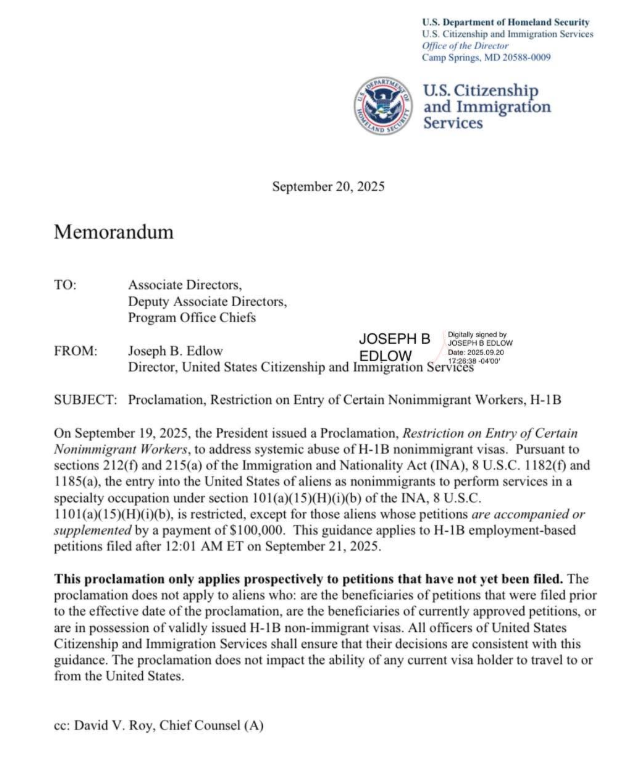
The proclamation was issued under sections 212(f) and 215(a) of the INA, which give the President authority to restrict entry into the United States when deemed in the national interest. The administration argues that these changes are necessary to prevent misuse of the H-1B program, which has often been criticized for displacing American workers or lowering wage standards in certain industries.
Importantly, the directive clarifies that the proclamation applies only prospectively to petitions that have not yet been filed. This means that beneficiaries of petitions filed before the effective date, those with approved petitions, or those already holding valid H-1B visas are not affected. The new rule does not impact the ability of any current visa holder to travel to or remain in the United States.
USCIS officers have been instructed to ensure their decisions remain consistent with this new guidance. The policy is expected to have significant implications for technology companies and other employers who rely heavily on H-1B workers for specialized roles. While firms can still file new petitions, they now face the additional burden of a $100,000 payment requirement for each petition, raising questions about how this might affect hiring strategies and costs for employers.
The memorandum was circulated to Associate Directors, Deputy Associate Directors, and Program Office Chiefs at USCIS, signaling the immediate implementation of this directive. The policy shift highlights the administration’s continued focus on immigration reform, particularly concerning employment-based visa categories.
As the proclamation takes effect, immigration attorneys, employers, and prospective foreign workers are expected to closely monitor its impact on the broader U.S. labor market and the country’s ability to attract global talent.
Disclaimer:
This article is for informational purposes only and does not constitute legal advice. Readers are advised to consult qualified immigration attorneys or official U.S. government sources for guidance on specific cases or petitions.