



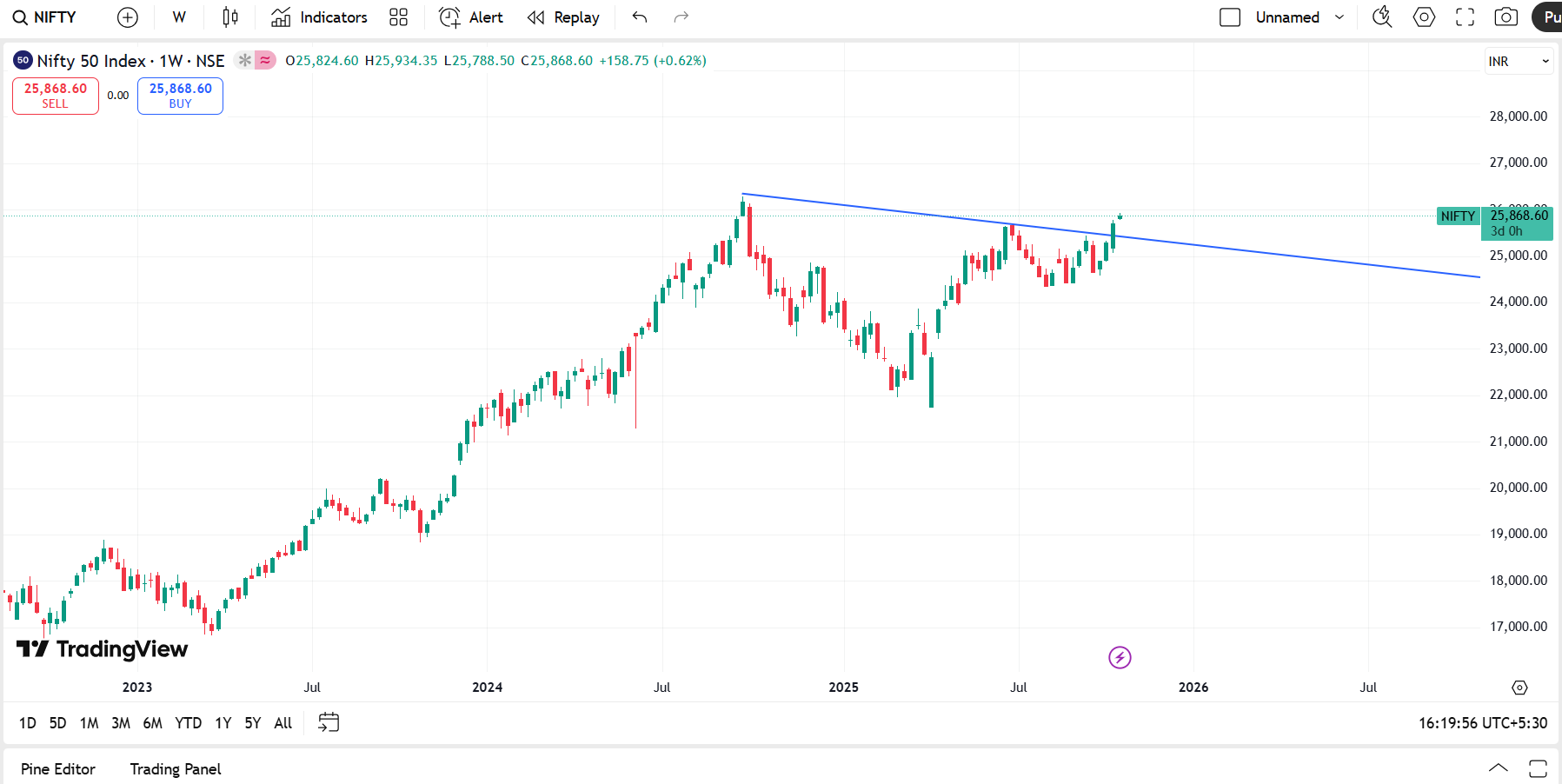
The Indian equity market has delivered zero returns over the past 15 months. An investor who deployed ₹1 lakh over a year ago would be sitting at nearly the same value today. Several frontline indices have even delivered negative returns. When inflation is factored in, real returns are negative.
This is a sharp contrast to previous years, where the Nifty delivered 20 percent returns in 2023 and close to 24 percent in 2024. In fact, 2025 has been the worst performance year in the last decade for Indian equities. The last time markets ended negative was in 2015. Even during the pandemic year 2020, markets closed positive. The 10-year CAGR for Nifty and Sensex stands at approximately 13.3 percent — but 2025 has so far contributed nothing.
While many investors blame the Trump effect, data suggests otherwise. The S&P 500 in the US has delivered 14 percent returns, while the Shanghai Composite in China delivered approximately 22 percent. Despite geopolitical tensions being far more aggressive between the US and China compared to India, both markets have outperformed. India, surprisingly, is the world’s worst performing equity market in 2025.
The core reason lies in index weightage breakdown.
Financial Services carries the highest weight in Nifty 50 at 37 percent. This segment has delivered strong performance. HDFC Bank, ICICI Bank and SBI have reported healthy business growth and positive stock returns.
The real drag is the IT sector, with a 14 percent weightage. TCS has delivered negative 27 percent returns in the last one year, with only 4 percent revenue and profit growth. Infosys is down 25 percent. HCL Tech is down nearly 20 percent. Oil and Gas has contributed additional pressure with ONGC down 13 percent and Coal India down 22 percent. FMCG remained muted, with ITC delivering negative 16 percent returns prior to GST-related recovery. Auto sector has done comparatively better, led by Bajaj Auto, Maruti Suzuki and Mahindra & Mahindra.
The global comparison provides clarity. In the US, 25 percent weight in the S&P 500 is technology — led by Nvidia, Microsoft, Amazon and others roaring due to the ongoing AI wave. Nvidia alone has delivered over 34 percent in one year with a 7.4 percent index weight. China’s Alibaba surged 111 percent. Artificial intelligence is the defining engine of global stock market momentum.
In sharp contrast, Indian IT companies are not innovating aggressively in AI. Global markets are rising because of AI. Indian markets are falling for the same reason — due to the lag in AI adoption by domestic IT giants.
The second major reason is FPI outflows. Foreign Portfolio Investors have sold over ₹1.6 lakh crore in the past one year, consistently offloading in the last three months. Factors include a weakening rupee, geopolitical uncertainty and superior opportunities in competing markets.
The third immediate pressure is policy uncertainty from the Trump administration. Aggressive stances on H1B visas and technology policies have created direct pressure, specifically on Indian IT firms.
However, going forward, GST reforms introduced in September are expected to revive FMCG and auto in the next quarters. The mid and small-cap IT companies have better AI adaptability potential, while large-cap IT may remain structurally slow compounders with 8–10 percent growth. Financial services are expected to remain strong growth drivers unless an unexpected global recession occurs.
Recent auto sales data supports revival signals — September reported record-high automobile numbers. Maruti Suzuki alone recorded over 1 lakh bookings in a week, particularly in small cars benefiting from recent GST cuts.
Individual stock picking is therefore preferred over index-based investing in such periods. Prolonged flat markets often provide deep discounts in fundamentally strong sectors. Several quality Indian companies are significantly undervalued right now, presenting rare accumulation opportunities before re-rating cycles begin.
Market direction will remain heavily influenced by IT sector recovery trends and FPI behaviour. Long-term investors are advised to stay selective and opportunistic rather than waiting for index-wide momentum.
Disclaimer:
This article is for informational and educational purposes only and should not be considered as investment, financial, or trading advice. Readers are advised to consult their financial advisor before making any investment decisions.