China has reiterated its call for peace and stability in the Middle East while emphasizing the urgent need to reopen critical shipping routes such as the Strait of Hormuz amid ongoing tensions involving Iran, the United States, and regional powers.
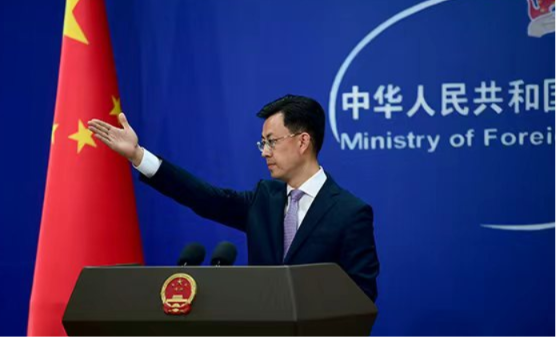
During a regular press briefing, Chinese Foreign Ministry spokesperson Guo Jiakun responded to a question regarding remarks from the White House claiming that, during talks between U.S. President Donald Trump and Chinese President Xi Jinping, China had agreed to help reopen the Strait of Hormuz.
Guo Jiakun did not directly confirm any specific agreement between Beijing and Washington regarding the strategic waterway. However, he outlined China’s broader position on the Iran crisis and the importance of restoring regional stability.
According to the Chinese Foreign Ministry spokesperson, the conflict has caused severe suffering for people in Iran and across neighboring countries. He warned that the expanding spillover effects are placing significant pressure on global economic growth, international supply chains, world trade, and the stability of global energy markets.
China stressed that continuing the conflict serves no constructive purpose and said the situation should never have escalated in the first place. Beijing stated that finding a rapid political solution is in the interests of not only Iran and the United States, but also countries across the Middle East and the wider international community.
Guo Jiakun welcomed the recent ceasefire efforts between the United States and Iran, as well as attempts to address disputes through diplomatic negotiations. He noted that these efforts have been positively received by countries in the region and by the broader international community.
China once again emphasized that dialogue and negotiation remain the only viable path forward, while warning that the use of force leads to a dead end. Beijing stated that now that channels for diplomatic engagement have reopened, they should not be closed again.
The spokesperson also highlighted the importance of maintaining momentum toward de-escalation and keeping the focus on political settlement through consultation and negotiations. China said all parties should work toward resolving the Iranian nuclear issue and related disputes in a way that addresses the concerns of every side involved.
A major part of China’s remarks focused on the need to restore maritime trade routes, particularly as global markets remain sensitive to disruptions in the Gulf region. Guo Jiakun said it is important to reopen shipping lanes as soon as possible in response to calls from the international community and to ensure global supply chains remain stable and uninterrupted.
The Strait of Hormuz remains one of the world’s most strategically important energy chokepoints, with a large percentage of global oil and gas shipments passing through the narrow waterway every day. Any disruption in the region can have immediate consequences for energy prices and global trade flows.
China also called for a comprehensive and lasting ceasefire to allow peace and stability to return to the Middle East and Gulf region at the earliest opportunity. Beijing stated that long-term regional security should be built on a sustainable security framework supported by diplomatic cooperation.
Guo Jiakun added that since the conflict began, China has consistently worked toward ending hostilities and promoting peace talks. He referred to President Xi Jinping’s “four propositions” aimed at safeguarding and promoting peace and stability in the Middle East.
The spokesperson also noted that China and Pakistan jointly issued a five-point initiative focused on restoring peace and stability in the Gulf and broader Middle East region.
China said it will continue acting in line with President Xi Jinping’s proposals and work alongside the international community to provide stronger support for peace negotiations while playing what it described as a constructive role in achieving lasting peace in the Middle East.