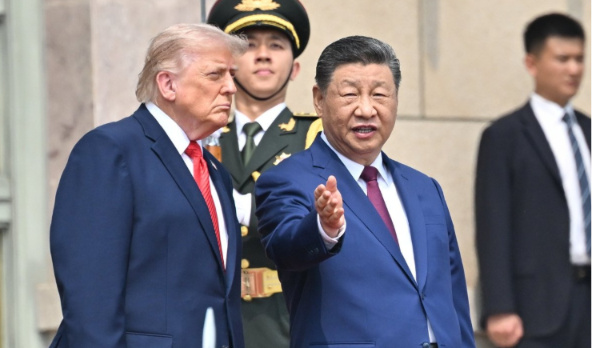
During a media briefing, Reuters asked China about the outcome of the latest meeting between Chinese President Xi Jinping and U.S. President Donald Trump, focusing on the future direction of China-U.S. relations and Beijing’s warning regarding Taiwan.
Responding to the questions, Chinese Foreign Ministry spokesperson Guo Jiakun said that President Xi and President Trump held talks earlier in the day and reached an understanding on what China described as a “new vision” for bilateral relations.
According to Guo Jiakun, both sides agreed on building a “constructive China-U.S. relationship of strategic stability,” which Beijing believes will provide long-term strategic guidance for ties between the world’s two largest economies over the next three years and beyond.
The spokesperson explained that “constructive strategic stability” includes several dimensions. He said it represents positive stability with cooperation as the main foundation of ties, healthy stability where competition remains within proper limits, constant stability where differences can be managed, and lasting stability supported by predictable peace between both nations.
China stated that it is prepared to work with the United States to transform this new diplomatic vision into practical actions. Beijing also emphasized its intention to cooperate with Washington in the same direction in order to maintain what it called steady, sound, and sustainable development of bilateral relations.
The comments come at a time when tensions between the United States and China continue over trade, technology restrictions, military activity in the Indo-Pacific region, and Taiwan.
Reuters also asked whether President Xi’s comments regarding Taiwan should be interpreted as a warning about the possibility of war if the issue is mishandled.
In response, Guo Jiakun reiterated Beijing’s longstanding position that Taiwan remains the most important and sensitive issue in China-U.S. relations.
Referring to President Xi’s remarks during the talks with Donald Trump, the spokesperson stated that if the Taiwan issue is handled properly, overall stability in bilateral ties can be maintained. However, he warned that mishandling the issue could lead to clashes and even conflicts between the two countries, placing the entire relationship in serious danger.
Guo Jiakun further stated that “Taiwan independence” and peace across the Taiwan Strait are fundamentally incompatible, describing them as “fire and water.” He added that maintaining peace and stability across the Taiwan Strait is the “biggest common denominator” between China and the United States.
The spokesperson also urged the United States to exercise “extra caution” in handling Taiwan-related matters.
China considers Taiwan a part of its territory under the “One China” principle and has repeatedly opposed U.S. military and political engagement with Taipei. Meanwhile, the United States maintains unofficial relations with Taiwan and continues to supply defensive weapons to the island under existing U.S. law.
The latest comments from Beijing highlight how Taiwan remains a central flashpoint in U.S.-China relations even as both sides attempt to stabilize broader diplomatic ties through renewed high-level engagement between President Xi Jinping and President Donald Trump.
As geopolitical competition between Washington and Beijing intensifies, analysts are closely watching whether both powers can maintain strategic stability while avoiding escalation over sensitive regional issues such as Taiwan and the South China Sea.