

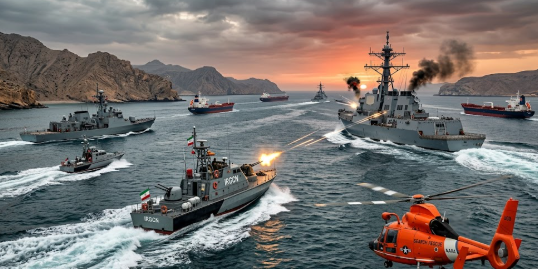
Tensions in the Middle East continue to escalate as the United States maintains a massive military buildup in the region while Britain and France reportedly move additional warships closer to the Strait of Hormuz. The growing naval presence comes amid rising concerns that Iran may attempt to tighten control over one of the world’s most important oil shipping routes.
During a televised discussion on the crisis, retired U.S. Navy Captain Bob Wells argued that Iran’s leadership remains unwilling to back down despite suffering major military setbacks in recent weeks.
According to Wells, many observers expected Tehran to surrender after key Iranian leadership figures were reportedly eliminated and significant portions of Iran’s naval infrastructure damaged. However, he said the Iranian government is still refusing to negotiate seriously because the Islamic Revolutionary Guard Corps (IRGC) continues to dominate the country’s strategic decision-making.
Wells described Iran as effectively being controlled by the IRGC rather than a traditional civilian government. He claimed the organization still holds significant leverage over Tehran’s military and foreign policy decisions.
The discussion also highlighted the scale of the American military presence in the Persian Gulf. Wells referenced a large number of naval assets and personnel currently operating in the region, including destroyers positioned near the Strait of Hormuz and inside the Persian Gulf.
Calls for “Project Freedom” Mission
Captain Wells strongly advocated for what he referred to as “Project Freedom,” a proposed effort aimed at guaranteeing safe maritime passage through the Strait of Hormuz for international commercial vessels.
He argued that the United States and allied forces should openly communicate to global shipping companies and seafarers that the international waterway will remain protected and operational despite Iranian threats.
According to Wells, Iran is not genuinely interested in negotiations and is instead attempting to delay discussions while maintaining pressure in the region.
The conversation also referenced comments from retired General Jack Keane, who reportedly believes that renewed military strikes on Iran may eventually become necessary if diplomacy continues to stall.
Criticism of Cease-Fire Efforts
Wells claimed that Iran achieved one of its main objectives through the previous cease-fire arrangement by successfully pausing military operations without making major concessions.
He stated that negotiators expected a new diplomatic agreement within weeks, but progress has reportedly remained limited even after more than a month.
According to the retired Navy captain, the United States should continue applying pressure on Tehran in order to weaken Iran economically and politically while increasing internal dissatisfaction among the Iranian population.
Growing Concerns Over Strait of Hormuz Control
The Strait of Hormuz remains one of the most strategically important waterways in the world, with a large portion of global oil shipments passing through the narrow channel every day.
Wells warned that Iran appears increasingly determined to exert control over the strait and surrounding islands, including locations allegedly being used to monitor and target international shipping traffic.
He also referenced reports that Iran recently established a new political agency dedicated to controlling the Strait of Hormuz, further intensifying regional concerns.
U.S. Secretary of State Marco Rubio was also mentioned during the discussion, with the argument that attempts to dominate the international waterway “should not stand.”
Focus on Maritime Security
According to Wells, the U.S. and its allies should continue escorting ships through safe transit lanes near the Omani side of the Strait of Hormuz, which he described as relatively clear and secure.
He explained that military escorts could include naval destroyers, Apache helicopters, and aerial surveillance assets designed to monitor any possible IRGC response.
The retired Navy captain also warned that Iranian drone activity and the possibility of ballistic missile attacks against Gulf nations remain major concerns.
In particular, he emphasized the need to reassure Gulf Cooperation Council nations, including the United Arab Emirates, Kuwait, Qatar, and Iraq, that the Strait of Hormuz will remain open to international commerce.
Wells stated that Western forces now possess better intelligence regarding the locations of Iranian fast attack boats and smaller naval vessels, which he described as one of the region’s primary security threats.
As tensions remain high, the future of negotiations between Washington and Tehran remains uncertain, while global energy markets continue closely watching developments around the Strait of Hormuz.
Disclaimer:
This article is based on publicly available broadcast discussions, expert commentary, and geopolitical analysis. Statements and opinions expressed by interview participants are their own and may not represent confirmed government positions or verified military intelligence. Readers should follow official government and defense sources for confirmed updates.