

June 24, 2026
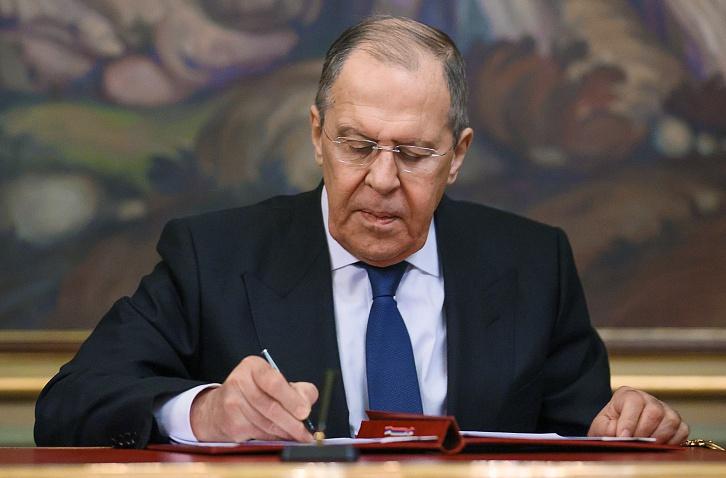
Russian Foreign Minister Sergey Lavrov has called for an inclusive and balanced regional security architecture in the Persian Gulf while welcoming recent diplomatic efforts aimed at reducing tensions between Iran, the United States, and regional powers.
Speaking at the Diplomatic Academy, Lavrov praised the ministerial meeting recently held in Jordan, where regional leaders discussed the restoration of navigation through the Strait of Hormuz, the conclusion of military operations, and broader security issues affecting the Middle East. He emphasized that Russia is not merely observing developments but is actively encouraging negotiations and diplomatic engagement.
Lavrov strongly criticized the military actions carried out by the United States and Israel against Iran, describing them as direct aggression against the Islamic Republic. According to him, accusations that Iran has been a center of terrorism for decades lack evidence and cannot justify military intervention.
The Russian foreign minister welcomed Washington's decision to return to diplomacy and acknowledged that reaching such a decision may have been difficult amid political disagreements. He stated that Russia is fully prepared to facilitate negotiations between the United States and Iran to help achieve a lasting settlement.
Lavrov also highlighted the mediation efforts led by Pakistan, Qatar, Saudi Arabia, Türkiye, and Egypt. He described the emerging regional dialogue format as constructive and aimed at creating reliable security conditions across the Middle East.
Russia has long advocated the creation of a comprehensive security framework for the Persian Gulf. Lavrov revealed that Moscow had organized multiple conferences involving experts, academics, and representatives from Gulf countries, Iran, Iraq, and Jordan. These discussions focused on confidence-building measures, transparency in military activities, and the development of a legally binding security arrangement similar to principles used by the Organization for Security and Co-operation in Europe (OSCE).
According to Lavrov, Russia recently updated and circulated its Gulf Security Concept to the Gulf Cooperation Council and Iran. He expressed hope that the initiative would help create a balance of interests among all regional stakeholders.
Lavrov noted that China had previously proposed similar security initiatives for the Gulf region, while countries such as Egypt and Saudi Arabia have also shown interest in shaping regional security mechanisms. He stressed that any future architecture must remain open, inclusive, and capable of addressing the concerns of all parties rather than targeting a specific country.
The Russian minister warned against building a security system directed against Iran. He argued that it would be a mistake for Arab countries to unite against Tehran and said that, fortunately, such proposals have not gained traction.
Referring to recent comments by US Vice President JD Vance, Lavrov welcomed suggestions that a broader regional agreement is needed to stabilize the Middle East. Russia, he said, is ready to participate actively in discussions regarding such initiatives.
On the Palestinian issue, Lavrov expressed deep concern over what he described as diminishing international attention toward Palestine. He argued that global efforts to remove the Palestinian question from the list of urgent international priorities were unfortunately succeeding.
Lavrov recalled a United Nations Security Council resolution introduced by the United States in 2025 regarding Gaza reconstruction. Russia and China abstained from voting rather than using their veto power after requests from Palestinian representatives and Arab countries. However, Lavrov criticized the resolution for failing to connect reconstruction plans with existing UN decisions regarding Palestinian statehood.
He also revealed that Russian President Vladimir Putin had officially informed Washington that Russia was prepared to allocate $1 billion from frozen Russian assets for Gaza reconstruction efforts. Nearly a year later, Lavrov said, Moscow is still waiting for a response from the United States.
The foreign minister questioned whether reconstruction efforts were genuinely intended to benefit Palestinians or whether alternative plans for Gaza were being pursued.
Lavrov further warned about developments in the West Bank and East Jerusalem. He stated that expanding Israeli settlements and territorial control could make the creation of a geographically continuous Palestinian state impossible.
He pointed to statements by Israeli Prime Minister Benjamin Netanyahu rejecting the establishment of a Palestinian state and expressed concern over discussions surrounding a "Greater Israel" concept. Lavrov also highlighted Israeli military activities in Syria as an additional source of regional instability.
While reaffirming Russia's commitment to Israel's security, Lavrov stressed that security cannot be achieved solely through territorial expansion, military pressure, or occupation. He argued that such approaches are unlikely to provide a sustainable solution to the conflict.
The Russian minister concluded by emphasizing the importance of Palestinian unity. He noted that various Palestinian factions have expressed willingness to participate in reconciliation talks, although significant divisions remain. According to Lavrov, a unified Palestinian position is essential for defending Palestinian rights and advancing prospects for a sovereign state.
Russia, he said, remains committed to supporting diplomatic efforts, regional stability, and a negotiated settlement that guarantees security for all countries while preserving the possibility of a viable Palestinian state.
Disclaimer:
This article is based on public statements made by Russian Foreign Minister Sergey Lavrov and reflects his views and positions. Readers are encouraged to consult multiple sources for a comprehensive understanding of ongoing geopolitical developments.