



In a severe blow to Britain’s automotive hub and the global luxury car market, Jaguar Land Rover (JLR)—the crown jewel of India’s Tata Motors—has been paralyzed by a massive cyber attack that first struck on August 31, 2025. What began as what seemed like a routine IT glitch has snowballed into nearly a month-long production freeze, shutting down JLR’s factories in the UK and abroad, threatening tens of thousands of jobs, suppliers’ survival, and billions in lost revenue.
As of September 24, JLR’s UK plants remain shuttered, with full recovery not expected until November, making this one of the most damaging cyber incidents in Britain’s industrial history. The attack has also sparked concerns about the fragility of “smart factories,” where hyper-connectivity has turned into a hacker’s playground.
The Attack: What Happened and Why It Hit So Hard
The breach was first detected on August 31, forcing JLR to proactively shut down its global IT systems to contain the fallout. By September 2, JLR confirmed “severe disruption” across its manufacturing, retail operations, and even vehicle registrations worldwide.
While the company admitted that “some data” had been compromised, it stopped short of confirming whether customer records, supplier details, or proprietary designs were exposed. This uncertainty has fueled speculation about the true scale of the breach.
Experts say JLR’s vulnerability lay in its hyper-connected “smart factories.” Since 2023, JLR has outsourced its IT systems and cybersecurity to Tata Consultancy Services (TCS) under a £800 million ($1 billion) deal to create AI-driven efficiency. But this integration also meant that one cyber breach rippled across every connected facility.
Production lines froze, suppliers lost access to orders, and even dealerships were unable to register new cars during the UK’s peak September plate-change period. A hacker group calling itself “Scattered Lapsus$ Hunters” has claimed responsibility, though investigators have not ruled out state-sponsored involvement. No ransom has been publicly confirmed.
Adding to JLR’s woes, reports suggest the company had missed renewing its cyber insurance policy, leaving it potentially uninsured for the crisis.
On social media, skepticism has swirled. Some users suggest the disruption is a convenient cover for JLR to accelerate production shifts overseas amid union tensions and weak Jaguar sales, while others speculate it could be an “inside job” to justify plant closures. JLR, however, has strongly denied these claims.
Timeline of the Shutdown
JLR’s three UK facilities—Solihull (Jaguar), Halewood (Land Rover), and Wolverhampton (engines)—normally produce around 1,000 vehicles a day, valued at £50 million ($67 million) weekly. The attack halted not just these sites but also JLR’s factories in Slovakia, China, Brazil, and India due to shared IT systems.
Key developments so far:
August 31, 2025: Attack detected; systems shut down. Immediate global blackout. Around 33,000 UK staff furloughed.
September 2: JLR confirms “severe disruption.” Tata Motors notifies Indian stock exchanges. Retail sales halt; stock dips 0.9%.
September 8–9: Shutdown extended; suppliers pause operations. Estimated £5 million per day in losses.
September 16: Closure stretched further; unions warn of job losses. Tata stock slips 1–2%.
September 23: Restart pushed to October 1. Supply chain “disintegration” fears rise; UK government holds talks with suppliers.
September 24 (today): No restart. Sources suggest full recovery may not occur until November. Cumulative losses exceed £200 million, while UK manufacturing output posts its sharpest decline in six months.
Currently, 33,000 JLR employees in the UK, plus thousands overseas, remain on standby. Many suppliers’ workers are on unpaid leave, prompting unions and MPs to call for government intervention. Business Secretary Peter Kyle met with suppliers on September 23 but no emergency financial support has been pledged.
Supply Chain Carnage
The disruption has rippled far beyond JLR. The company’s just-in-time supply chain model relies on hundreds of European suppliers, many of whom have been forced to idle operations or even consider bankruptcy. Some workers have already been laid off or are signing up for benefits.
September’s S&P Global PMI data flagged the JLR disruption as a key reason for UK manufacturing output’s steep drop. Experts at the Royal United Services Institute (RUSI) called it “unprecedented” for a cyber incident to cripple a UK industrial giant in this way, warning that it highlights broader resilience gaps across the auto industry and beyond.
Globally, the attack is part of a worrying trend: hackers increasingly targeting high-value supply chains in sectors from airports to retailers.
Why Tata Motors Stock Is Falling
The impact of this cyber attack is being felt sharply in Mumbai, where Tata Motors’ shares have come under sustained pressure. Here’s why investors are nervous:
Production Losses: With 1,000 vehicles per day offline for nearly a month, Tata Motors faces losses exceeding £200 million ($260 million), wiping out potential Q3 profits.
Supply Chain Strain: Supplier bankruptcies could disrupt JLR’s recovery even after factories reopen, raising questions about delivery schedules.
Uninsured Costs: Reports that JLR had no active cyber insurance amplify concerns about how much of the financial hit Tata must absorb directly.
EV Delays and Tariffs: Already hit by U.S. tariffs and delayed EV launches (Range Rover EV now expected only in 2026), this crisis compounds JLR’s challenges.
Investor Sentiment: The market views the cyber attack as a sign of deeper structural risks in JLR’s reliance on “smart factory” networks, hurting confidence.
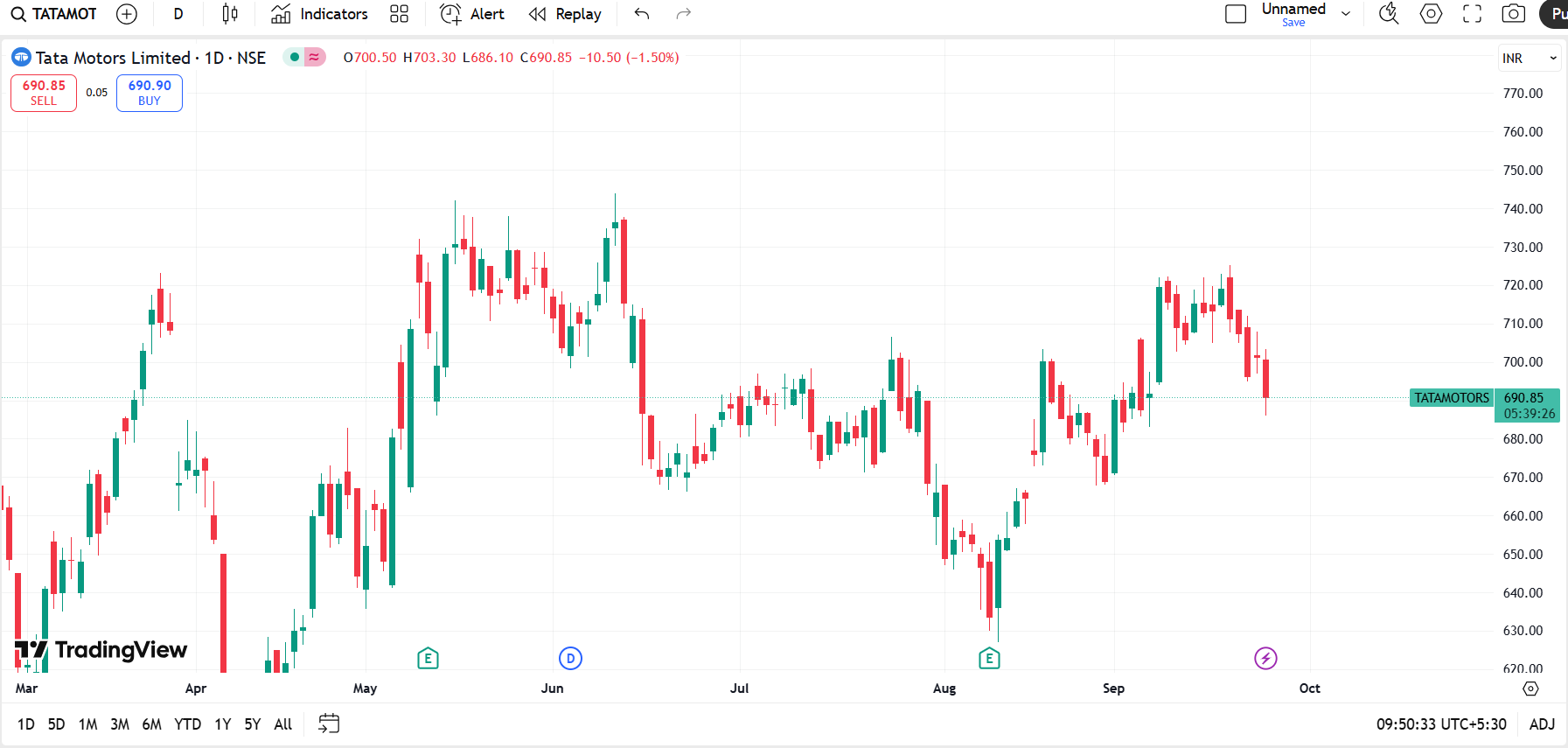
Tata Motors Chart
For Tata Motors, JLR has long been the crown jewel driving its global luxury positioning. But now, a hacker-induced meltdown threatens to become one of the toughest tests in its ownership history.
Conclusion
This cyber attack has exposed just how fragile globalized, hyper-connected manufacturing has become. For JLR, the fallout is more than just a temporary production hiccup—it’s a crisis that could reshape its operations, supply chain, and financial outlook. For Tata Motors, it’s a blow that’s rattling investors and highlighting the risks of running a complex international auto empire in an era of rising cyber threats.