

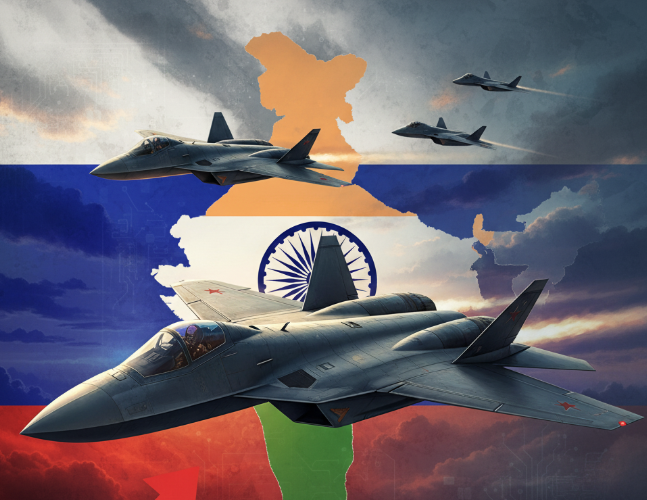
In a major development that could reshape Indo-Russian defense ties, Russia has formally proposed supplying its advanced fifth-generation Su-57 stealth fighter jets to India, with options for joint production and full localization on Indian soil. The move, reported on September 23–24, 2025, comes at a critical juncture as the Indian Air Force (IAF) faces squadron shortages and long timelines for indigenous projects like the Advanced Medium Combat Aircraft (AMCA). With the U.S. simultaneously pitching the F-35, Moscow’s offer is set to spark a new strategic debate in New Delhi.
Background: A Long-Standing Partnership
India and Russia share a decades-long defense relationship, with Moscow supplying more than 60% of India’s military hardware. Notable milestones include the licensed production of over 260 Su-30MKI fighters at Hindustan Aeronautics Limited (HAL) in Nashik, as well as the BrahMos missile joint venture.
The Su-57 proposal revives memories of the earlier Fifth Generation Fighter Aircraft (FGFA) program, launched in 2007 as a derivative of Russia’s PAK FA project. India invested $295 million in design work but withdrew in 2018, citing concerns about stealth effectiveness, engine maturity, and cost-sharing.
Now in 2025, Russia has returned with a stronger pitch. The Su-57 is in serial production and has been combat-tested in Ukraine against Western defense systems such as Patriot and IRIS-T. Ahead of Aero India 2025, the Su-57E (export variant) wowed audiences with flying demonstrations in Bengaluru. Recent reports from TASS and Indian outlets confirm the offer’s revival, with Moscow highlighting “unprecedented” technology transfers aligned with Prime Minister Narendra Modi’s “Make in India” and “Aatmanirbhar Bharat” programs.
The Proposal: Supply, Build, and Innovate
Rosoboronexport CEO Alexander Mikheev and United Aircraft Corporation (UAC) officials have outlined a three-pronged package for India:
Direct Supply: Initial deliveries of Su-57E jets, possibly two squadrons (36 aircraft), directly from Russian factories to quickly fill IAF’s urgent needs. With just 30 operational squadrons against a sanctioned 42, the gap is becoming critical.
Joint Production: Local assembly at HAL’s Nashik facility, using the existing Su-30MKI production ecosystem. Russia envisions joint production of 3–5 squadrons (54–90 jets), with India overseeing assembly, testing, and upgrades.
Technology Transfer: Full access to avionics source code, stealth coatings, and weapons integration. This would allow India to add indigenous systems such as the Uttam AESA radar and Astra missiles. Russia has also offered to support India’s own fifth-generation fighter efforts, potentially expediting the AMCA program.
Naval Variant Tease: Russia has hinted at a carrier-capable Su-57 version for India’s INS Vikrant and future carriers, though India’s current focus remains land-based platforms.
Pricing has not been finalized, but estimates suggest $70–80 million per Su-57E, competitive with the F-35A at $80 million. With local production reducing logistics and operating costs, the Su-57 could be a cost-effective choice. Delivery schedules are also attractive, with Russia promising fast rollouts, similar to how the S-400 missile system deliveries are on track to finish by 2026.
Comparison: Su-57 vs. F-35A
A head-to-head comparison puts the competition in perspective:
Russian Su-57E: Features include stealth, supercruise capability, thrust-vectoring engines (AL-41F1, upgradable to Izdeliye 30), and multirole versatility with 10 hardpoints. Joint production at HAL and full technology transfer are key selling points.
U.S. F-35A: Known for superior sensor fusion, advanced electronic warfare suite, and a vertical takeoff variant. However, it would be offered only as off-the-shelf sales, without co-production rights. Both jets are similarly priced, around $80 million per unit.
Strategically, the Su-57 aligns with “Make in India” and builds on the Su-30MKI ecosystem, while the F-35 strengthens India’s position within the QUAD and balances China.
Strategic Implications: A Potential Game-Changer
For India, the Su-57 offer is about more than just advanced aircraft. It is also about geopolitics and technological sovereignty. The jets could give India immediate fifth-generation capabilities to counter China’s J-20 and Pakistan’s upcoming J-35A. They could also accelerate HAL’s expertise for the AMCA, expected to fly by 2032.
Russian Ambassador Denis Alipov called the proposal a “game-changer” at the India Today Conclave in June, stressing that the Su-57 has proven itself in “real-world combat” as opposed to simulations.
Still, critics warn of risks. Sanctions under CAATSA could complicate deals involving Russian defense technology, and some experts question the Su-57’s stealth performance, with a radar cross-section estimated at 0.1–1 m² compared to the F-35’s 0.001 m².
On social media, the debate is heated. Posts on X (formerly Twitter) on September 24 drew thousands of views, with hashtags like #Su57Supremacy and #F35Debate trending. Some users framed the offer as “BRICS flexing against NATO,” especially after Modi’s meeting with Vladimir Putin at the SCO summit.
The deal also ties into a larger $30 billion Indo-Russian defense cooperation pipeline, which already includes S-400 systems and AK-203 rifles. Analysts note that Russia is playing the long game: supplying equipment now while supporting India’s technological sovereignty in the future.
What’s Next?
According to reports from CNBC-TV18, India’s Ministry of Defense is actively studying the proposal, and a Request for Information (RFI) could be issued by late 2025. High-level negotiations may intensify during the next India-Russia summit.
For now, the future of the Su-57 in India depends on how New Delhi balances technology, cost, and geopolitics. The decision could shape the IAF’s air power for decades to come.
This story is developing. The big question remains: should India go for the Su-57 to strengthen ties with Russia and boost Make in India, or hold out for AMCA and consider U.S. options like the F-35?